Ugly Americans, Ugly Thais
On January 26, 2015, the assistant secretary of state for East Asian and Pacific affairs, Daniel R. Russel, delivered a speech at Chulalongkorn University, urging the end of martial law throughout the country and the […]
Writing in Democracy in America, Alexis de Tocqueville famously declared the ‘general equality of conditions’ the foundation of American democracy. For Thailand, it is different, for it is the general inequality of condition that defines […]
Kamin Kamani (คามิน คมนีย์). เย็นวันเสาร์-เช้าวันอาทิตย์ (The Sunday Morning Club)Bangkok: Amarin Publishing, 2004 (1st edition); Banbook Publishing, 2014 (2nd edition). Kamin Kamani (คามิน คมนีย์). หัว*ใจ*เท้า (Head, Heart and Feet)Bangkok: Banbook Publishing, 2014. As symptoms of determination, […]
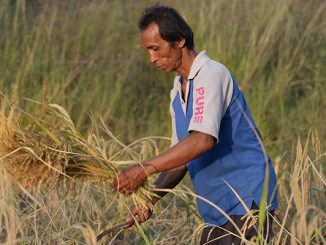
The general question of Thai rice production, and its prospects – as a problem, or series of problems, requiring and necessitating further investigation – interlinks with a number of other important ongoing questions, factors, and […]
Since the early 1990s, Southeast Asian governments have turned their attention to a new kind of economic activity, sometimes dubbed the “creative economy.” At the center of this movement are those innovative industries that are […]
Since the early 1990s, Thailand has experienced two decades of movements toward more decentralization—i.e. the transfer of authority, responsibility, and resources from the central government to local ones. While local development is flourishing, there are […]
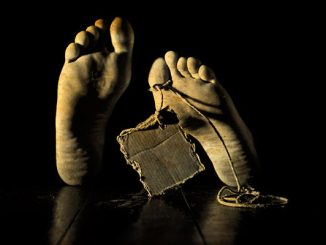
In Thailand, the devastating 2004 Indian Ocean Tsunami was followed by an unprecedented effort to identify the dead. Thai governmental, non-governmental, and international agencies rushed to the scene, followed closely by teams of forensic experts […]
German scholar, Benjamin Baumann, writes about Phi Krasue, one of the most well-known and most frightening uncanny beings of Thai folklore. Like most uncanny beings classified with the pre-fix Phi, Phi Krasue had no singular origin myth that reached beyond the local discourse, but that changed in 2002 with the release of the Film “Tamnan Krasue” which locates the origin of this uncanny being in 13th century Angkorian Khmer culture. This article offers interpretations as to why this idiosyncratic origin myth appeared in the aftermath of the Asian Financial Crisis and how it may contribute to our understanding of contemporary Thai-Cambodian relations. […]

The inaugural article in the Young Academic’s Voice stresses the urgent need for the Thai government to remodel its national agencies in order to bring about much-needed fiscal decentralisation, and by doing so, avoiding bankruptcy for local authorities. […]
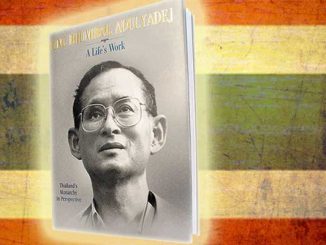
Nicholas Grossman and Dominic Faulder (eds.). 2011.King Bhumibol Adulyadej, A Life’s Work: Thailand’s Monarchy in Perspective.Singapore: Editions Didier Millet. 383 pages. In 2008, when it had become impossible for any credible journalist to ignore the entanglement […]
The Future of the Monarchy in Thailand The future of any monarchy is at least partially determined by the strengths and weaknesses of its current reign and the path of succession to the next. This […]
Monarchies in Southeast Asia Professor Michael Leifer, the late much respected scholar of Southeast Asian studies, wrote a preface for the critically acclaimed book by Roger Kershaw titled, Monarchy in Southeast Asia. Leifer said, “It is […]
The Fate of Rural Hell: Asceticism and Desire in Buddhist Thailand. Benedict Anderson. Calcutta: Seagull books. 2012. 99 pp. Classical studies of Thai rural society often begin at a wat. From an anthropological perspective, the wat, or […]
Corpses are frequently encountered in the Christian religious cultures of Europe and the Americas. Without the need for a quick burial and restrictions on dismemberment in Judaism and Islam, Christians have spent a lot […]
This morning I went to pay my respects to the heroes of 14 October and 6 October… Every week or two, I buy two flower garlands and go to pay my respects in front of […]
This essay is a study of two novels, Seni Saowaphong’s Pheesart (Ghosts) and Chart Korbjitti’s Khamphiphaksa (The Judgement). Both masterpieces represent the pinnacle of what is valued as belles lettres in Thai literature. But because […]
Thank you very much, Acharn Giles. The title of my talk, “A Country is a Company, a PM is a CEO,” is based on a statement Prime Minister Thaksin Shinawatra made in November 1977 when […]
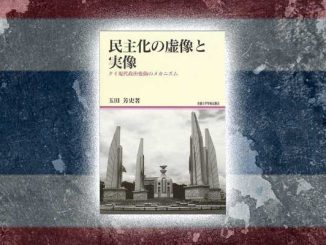
Democratization in Thailand: Grappling with Realities『民主化の虚像と実像-タイ現代政治変動のメカニズム』Tamada Yoshifumi玉田芳文Kyoto / Kyoto University Press / 2003 Dr. Tamada Yoshifumi, a distinguished scholar of modern Thai politics at Kyoto University, was awarded the 20th Masayashi Ohira Memorial Prize in 2004 for this […]
In the northern reaches of the modern Thai nation-state, along the borders of Myanmar and Laos, people have been on the move since ancient times following seasonal migration routes, pursuing trade, and making new settlements. […]
Human trafficking from mainland Southeast Asia in the modern period started in the 1960s in connection with the presence of United States troops in Indochina. The foreign male clients of the sex trade at […]
Six recent research reports on human trafficking will be summarized to illustrate current trends and problems faced by migrants. The reports are: The Migration of Thai Women to Germany: Causes, Living Conditions and Impacts […]
The essence of Prime Minister Thaksin Shinawatra’s Dual Track Policy is an effort to maintain stable economic growth: a slowdown in exports due to slackening external demand would be met with a boost in domestic […]
The economic crisis of 1997 affected everyone in Thailand, even His Majesty the King. Seeing many of his subjects suffering, he advised the Thai people to change their economic philosophy in order to cope with […]
There are certain periods when historical discourses and their politics – who controls them, the mode by which they are disseminated, how competing histories are suppressed – become central to intellectual or public debate. […]
The violence which culminated in the burning of the Royal Thai Embassy in Phnom Penh on January 29, 2003, was both shocking and unexpected. The rioting not only inflicted extensive damage to Thai-owned property (fortunately, […]
Translator’s Note. By the mid 1980s, Nidhi Eoseewong was established as one of the most original historians of Thailand. From around 1985, he wrote a series of long essays which use historical perspective to analyse […]
Let me begin with a poem. I composed it in hiding at the house of one of my aunts right after the 6 October 1976 Massacre at Thammasat University in Bangkok, in which the radical […]
Anan Ganjanapan Local Control of Land and Forest: Cultural Dimensions of Resource Management in Northern Thailand Chiang Mai / Regional Center for Social Science and Sustainable Development, Faculty of Social Sciences, Chiang Mai University […]
Copyright © 2024 | Kyoto Review of Southeast Asia | All Rights Reserved