
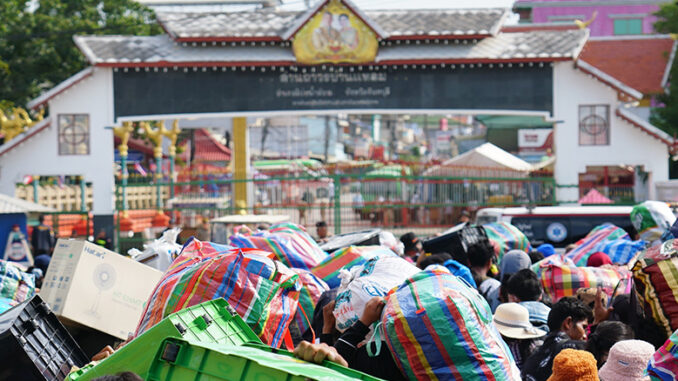
In mid-June, amid escalating tensions between Cambodia and Thailand over a protracted border dispute, Cambodia’s de facto leader, Hun Sen, urged members of the Cambodian diaspora to “return to our homeland before [they] are forcibly expelled.” The scale of the response likely exceeded expectations. By 11 August—eighteen days after hostilities erupted between the two countries’ militaries—an estimated 920,000 Cambodians had crossed back over the border from Thailand. Prior to the conflict, Cambodia’s labor force consisted of about nine million individuals, meaning returning adults accounted for nearly one-tenth of the workforce (ILO, 2022). The precise number remains uncertain, as many had been working in Thailand without legal status or adequate documentation.
As during the COVID-19 pandemic, the Cambodian government has moved to absorb the influx of returning migrants through job creation schemes and some financial assistance. By 10 September, roughly 220,000 returnees had secured employment, more than half through government-sponsored schemes (Khmer Times, 2025). Yet social media is filled with complaints of rejection from employers, and fears are mounting that joblessness and lost remittances are driving household debt—already over 100 percent of GDP before the conflict (NBC, 2024)—toward destabilizing levels. There are some concerns that it could imperil the financial sector itself. Government projections suggest that only about half of returnees will find work, and it is uncertain whether Thailand will reopen its labor market once tensions ease.
Scholarship on non-traditional security has long examined the risks associated with mass immigration and emigration. Less attention has gone to large-scale return migration—or “mass remigration”—and its potential to destabilize origin states.[1] The Association of Southeast Asian Nations’ (ASEAN) Security Outlook reports in 2015 and 2021 listed “illegal migration” as a non-traditional security threat, but not remigration, despite persistently high labor outflows across the region. Cambodia has some historical experience, having absorbed hundreds of thousands of refugees from Thai camps in the 1980s and 1990s. However, the pace and labor market context today are markedly different.
In 2024, Phnom Penh stated that 1.3 million Cambodians were working abroad, with 1.2 million in Thailand (Khmer Times, 2024). According to one estimate, overall remittances account for approximately 9 percent of Cambodia’s economy, comparable to the Philippines and significantly higher than other Southeast Asian states (ESCAP, 2024). The World Bank estimates that personal remittances accounted for 6.1 percent of GDP last year, which would amount to approximately $2.8 billion (World Bank Open Data). However, a Yuanta Securities (2025) study estimated that Cambodian workers in Thailand send home approximately $1.5 billion annually, equivalent to around 2 percent of the country’s GDP. The bank projected that if 20 percent of returnees secured domestic work, productivity and consumption gains could offset remittance losses; full reabsorption could generate $7.2 billion.

Yet, as with most traditional or non-traditional security threats, the risks lie less in aggregate than in the extremes. Roughly 30 percent of returnees were already classified as poor, and this could rise to half if jobs fail to materialize (CDRI, 2025). A 2020 survey found most Cambodians returning from Thailand suffered major income declines, with nearly one-third reporting losses of at least 40 percent (IOM, 2020). As of 10 September, the Ministry of Labor reported that approximately 220,000 returnees had secured formal employment, while tens of thousands more had found work informally. With an additional 90,000 job vacancies available, these figures suggest that, at best, just over half of the returnees are likely to secure employment (Khmer Times, 2025).
Several structural factors constrain labor absorption. Most migrants originate from Cambodia’s western border provinces, whereas employment opportunities are concentrated in the country’s east, near Phnom Penh, the capital (CDRI, 2025). Yet studies also show that returnees prefer to stay near their home provinces (Hatsukano, 2019, p. 68). Consequently, returnees often face a dilemma: either remain in their home villages, where social networks and subsistence resources are available but formal employment is scarce, or internally migrate to areas with greater job prospects but weaker safety nets and higher relocation costs. Occupational continuity is also limited: only construction workers tend to retain their trade, while most cannot transfer Thai-acquired skills back home (Hatsukano, 2019, pp. 66–67). This is particularly acute, given that most Cambodians in Thailand had worked in construction or agriculture, two sectors that are still struggling post-pandemic. Compounding this is the fact that remittances disproportionately sustain rural economies. Age also poses a significant barrier. More than one-quarter of returnees are aged 45 years or older, which limits their access to labor-intensive sectors, such as garment manufacturing, Cambodia’s largest formal employer. Anecdotal reports suggest that many returnees have been rejected by garment factories due to their age.
Household debt represents the gravest economic risk. Around one-third of households with migrant members already held loans averaging $5,000, many struggling with repayments (CDRI, 2025). Cambodia’s debt-to-GDP ratio stood at 124 percent in 2024 (NBC, 2024), among the world’s highest. The costs of remigration, coupled with lost incomes, are expected to deepen distress. Although Prime Minister Hun Manet urged lenders to restructure debts, non-performing loans had already risen to 7.9 percent in banking and 9 percent in microfinance by the end of 2024, up sharply from previous years (Xinhua, 2025). These have almost certainly increased since June. The IMF (2025) warned that temporary relief must be paired with a “carefully calibrated exit from regulatory forbearance” to ensure banks recognize loan losses. At a minimum, a surge in household debt and unmanageable credit repayments will incur substantial social costs, including reduced access to healthcare and other essential services. Local media have reported cases of returnees trying to re-enter Thailand despite border violence, driven by urgent debt obligations (Kiripost, 2025).

Whether migrants will be allowed back into Thailand once tensions subside is pivotal. For Phnom Penh, the dilemma is double-edged: an outflow would ease immediate pressures but undermine domestic firms that expanded in expectation of new workers. Yet the decision rests with Bangkok, which has recently liberalized laws to employ Myanmar refugees and engaged in talks with Sri Lanka, Nepal, Indonesia, and the Philippines about boosting migration from those countries, signaling intent to diversify away from Cambodian labor.
If returnees remain, further pressures mount. More than 50,000 new school places would be required, straining an underfunded education sector. Many Cambodians rely on Thai healthcare for serious treatment. The wealthy can still make the journey by plane, but land-based travel has been halted by the ongoing conflict, putting additional pressure on Cambodia’s underfunded healthcare system.
A more insidious risk lies in the cyber-scam industry, arguably the most significant non-traditional security threat to Cambodia at present. According to one estimate, the illicit sector generates around $12.5 billion in revenue annually, equivalent to a quarter of the formal economy (USIP, 2024). The alleged patronage of the industry by Cambodia’s political and business elites has prompted US sanctions and disagreement with China. Many of the scam compounds are located near the Thai border, and most people working in them are allegedly kept in slave-like conditions.
The government has acted quickly, creating job schemes, organizing ministerial task forces to advise the returning workers on employment opportunities, lobbying employers to hire the returning migrants, and offering financial assistance. For the most part, the government has been proactive in its response. Still, social media is awash with complaints from returnees that they haven’t been able to access the services and support they were promised.
In the long term, this could create novel political security challenges for the ruling Cambodian People’s Party (CPP), which has held a monopoly on power since 1979. The authoritarian party has successfully closed down all political and public opposition since 2017, and dissent is now very rare. Currently, nationalism is running high in Cambodia, and much of the blame for this crisis, including the forced re-migration, is directed at Thailand, not Cambodia’s government. Indeed, many Cambodians opted to leave over concerns that they would be attacked by jingoistic Thais.
Much will depend on how long the tensions persist between Cambodia and Thailand, and whether the migrants will be allowed to return to jobs in Thailand in large numbers. No other country is likely to take in 1 million Cambodian workers. In the past, Cambodians dissatisfied or aggrieved with their life options had the ability to migrate to Thailand to find better-paying work. To a degree, this benefited the ruling party by removing from the country the people most aggrieved by their fate. Moreover, the ability of Cambodians to easily migrate to Thailand in large numbers meant that Phnom Penh has, in recent decades, not had to struggle with the prospect of mass unemployment or, in terms of labor rights, high levels of surplus labor.

What does Cambodia’s case reveal about mass remigration as a non-traditional security threat? As with other novel security threats (and, indeed, many traditional ones), it is concerning primarily because it magnifies existing vulnerabilities. While a sudden spike in unemployment is problematic in almost any context, it is particularly destabilizing in Cambodia, where rates of indebtedness and loan non-repayment are already high and worsening. A black swan event of this magnitude has the potential to transform a chronic vulnerability into an acute crisis. The social risks are further exacerbated by Cambodia’s ongoing challenges, including the expansion of its vast cyber-scam industry. Had the agricultural and construction sectors recovered to pre-pandemic levels or better, and had job creation been concentrated in the country’s western provinces rather than around the capital, the economic consequences of mass remigration would likely have been more contained.
These vulnerabilities weren’t unforeseeable. Cambodia’s over-reliance on Thailand as the primary destination for labor migration left it particularly exposed. This contrasts with countries such as the Philippines, which maintains a far more diversified pattern of labor export. The risks are also contingent on what triggered the mass remigration. Such movements may result from armed conflict, sudden economic shocks, environmental disasters, or mass deportations. In Cambodia’s case, the exodus was started by a territorial dispute with the host country, Thailand. This dynamic has dampened political risks by redirecting public anger outward: pervasive nationalist sentiment has rallied many Cambodians behind the national flag and the government while blaming Thailand for the country’s difficulties. How long this lasts is worth watching, as it may provide an interesting example in Southeast Asia of how long emotion-led fury (such as nationalism) can subsume bread-and-butter concerns (like jobs and debt). Moreover, there is a need for further research, particularly comparative studies, on how differing economic structures, migration patterns, and political contexts influence the security risks associated with mass remigration.
David Hutt
Research fellow at the Central European Institute of Asian Studies (CEIAS) and the Southeast Asia Columnist at The Diplomat.
References –
“Cambodia’s Banking, Financial Institutions Experience Slow Credit Growth in 2024: central bank.” Xinhua, 19 February 2025. https://english.news.cn/20250219/f7d820199f91437a8dbfe90f7868fb03/c.html.
“Cambodia: Employment and Environmental Sustainability Factsheet.” International Labor Organization. 2022. https://www.ilo.org/media/368836/download.
“Cambodia Returning Migrants Survey.” International Organization for Migration, 2020. https://dtm.iom.int/dtm_download_track/11936?file=1&type=node&id=9270.
“Demographic and Economic Profile of Returned Migrant Labourers.” Cambodia Development Resource Institute, 27 August 2025. https://cdri.org.kh/publication/demographic-and-economic-profile-of-returned-migrant-labourers.
“Expert Group Meeting on Strengthening the Evidence Base on Migration in North and Central Asia.” Economic and Social Commission for Asia and the Pacific, 3 December 2024. www.unescap.org/sites/default/d8files/event-documents/Remittances_in_NCA_ENG_20241126.pdf.
“Financial Stability Review.” National Bank of Cambodia, 2014. https://www.nbc.gov.kh/download_files/publication/fsr_eng/FSR_2024_Final_250512@10am.pdf.
“From Remittances to Resilience: Harnessing Returning Migrant Workers for Cambodia’s Growth.” Yuanta Securities, 25 August 2025. https://yuantacambodia.com.kh/yuantaReport.php?Special%20Report&report=1126.
“Govt Provides Robust Assistance to 1.3 Million Migrant Workers.” Khmer Times, 11 July 2024. https://www.khmertimeskh.com/501521096/govt-provides-robust-assistance-to-1-3-million-migrant-workers.
Hatsukano, Naomi. 2019. “Returned Migrant Workers in Cambodia: Motivations for Moving and Economic Reintegration.” Institute of Developing Economies. https://www.ide.go.jp/library/English/Publish/Reports/Ec/pdf/201902_02_ch03.pdf.
“IMF Staff Completes 2025 Article IV Mission to Cambodia.” International Monetary Fund, 2 September 2025. https://www.imf.org/en/News/Articles/2025/09/02/pr-25287-cambodia-imf-staff-completes-2025-article-iv-mission.
“Over 220,000 Cambodian Returnee Workers Secure Jobs, Says Labour Minister.” Khmer Times, 13 September 2025. https://www.khmertimeskh.com/501756456/over-220000-cambodian-returnee-workers-secure-jobs-says-labour-minister/.
“Personal Remittances, Received (% of GDP)–Cambodia.” Work Bank Open Data. https://data.worldbank.org/indicator/BX.TRF.PWKR.DT.GD.ZS?locations=KH.
Sikol, Kuch. 2025. “Debt and Job Shortages Force Cambodian Workers to Return to Thailand.” Kiripost, 8 September 2025. https://kiripost.com/stories/debt-and-job-shortages-force-cambodian-workers-to-return-to-thailand.
“Transnational Crime in Southeast Asia: A Growing Threat to Global Peace and Security.” United States Institute of Peace, 13 May 2024. https://www.usip.org/publications/2024/05/transnational-crime-southeast-asia-growing-threat-global-peace-and-security.
Notes –
[1] There have been some studies on this. For instance, Schwartz, S. 2019. “Home, Again: Refugee Return and Post-Conflict Violence in Burundi.” International Security, 44 (2): 110–145; Wanki, P., I. Derluyn and I. Lietaert. 2022. “‘Let Them Make It Rain and Bling’: Unveiling Community Expectations towards Returned Migrants in Cameroon.” Societies,12(1). However, many of these studies focus on reintegrating either refugees or deportees, not migrant workers. Moreover, many focus on ethnically diverse countries, such as the former Yugoslav states or African countries, and not on ethnically and culturally homogenous countries, such as Cambodia, where remigration has almost no cultural concerns.