
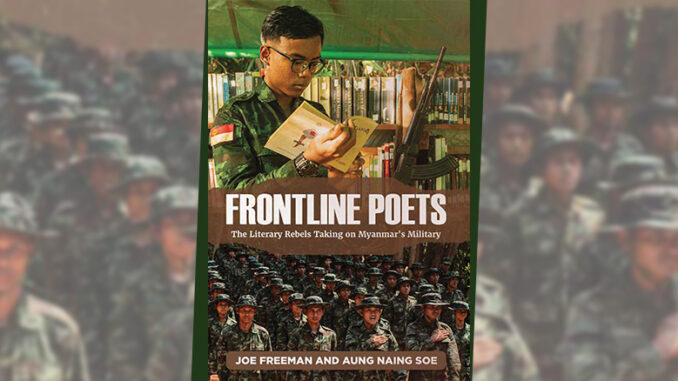
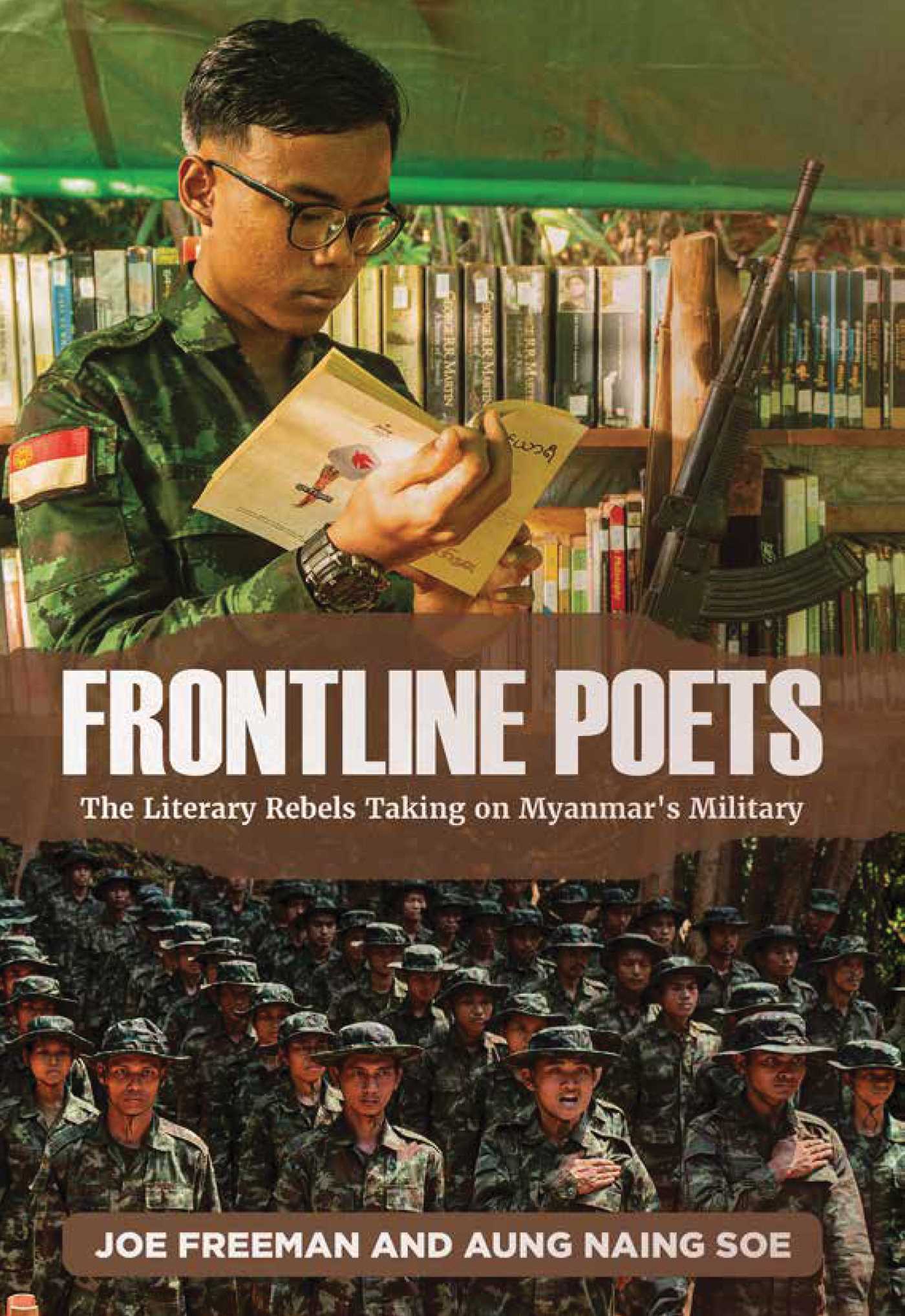
Title: Frontline Poets: The Literary Rebels Taking on Myanmar’s Military
Authors: Joe Freeman, & Aung Naing Soe
Publisher: River Books, (2025)
Less than a month before he was killed, President Kennedy spoke in honor of the decorated American poet, Robert Frost, who had died nine months before. Frost “saw poetry as the means of saving power from itself”, said Kennedy. “When power leads men towards arrogance, poetry reminds him of his limitations … When power corrupts, poetry cleanses”.[1]
That power has turned the men of Myanmar’s military arrogant and corrupt for more than sixty years is tragically clear, and no more so since February 2021, when they took it back by force after a decade-long democratic experiment. Holding on to that power has proven difficult, however, thanks to a loose nationwide alliance of diverse resistance forces; a brutal civil war has just entered its sixth grinding year. While some of those firing back, mostly armed groups of religious and ethnic minorities, have been doing so for all or part of the same sixty years, others are new, including those seeking to remind the army of its limitations: the titular ‘frontline poets’ of a new book by Joe Freeman and Aung Naing Soe.
On the large canvas of the conflict, spanning a country the size as Texas and a population of 55 million, the number of ‘literary rebels taking on Myanmar’s military’ is frankly miniscule, and their involvement has not affected, and will not affect, the outcome of the ‘revolution’. But if Frontline Poets contains a single message—implicit but unmistakable—it is that these writers represent a constituency of exponentially greater scale, scope and, therefore, significance. A constituency of people who once earned their livings and spent their time doing literally anything other than firing weapons—textbook civilians—before concluding that only by firing weapons could they hope to carry on. People who had taken to the streets and gone on strike before concluding, in poet Maung Saungkha’s words, that “peaceful protests will not work”. Doctors, nurses, teachers, students, shopkeepers, bus drivers, traders, even local officials: the poets on the frontline are not alone, and that could tip the scales.
The authors focus on five contemporary poets in particular and, through them, introduce perhaps a dozen more. They begin by situating them not only in the Myanmar of their experience, but in the country’s long and important poetic tradition and transformation. Originally in the cultural domain of religion, romance, and the royal courts, poetry took its modern character in response to colonialism: “Through war, exploitation, persecution, national humiliation, and diminishment,” the book notes, “the British can be credited indirectly with making poetry political in Burma.” For a century and a half then, poetry in Myanmar has been almost entirely an art of resistance, an assertion of freedom of expression in both its exercise and object. This pedigree makes the remainder of the book more meaningful for the reader, not least because the poets themselves draw upon it for meaning and purpose to their precarious lives and the loss of their friends.
The book also recounts Myanmar’s recent political history and current civil war through the poets’ stories—and in some cases, their poems—again providing the reader with the same context that impelled each of them to write and fight. Its shorthand is a litany of violence and violations: Nargis, Letpadaung, Meiktila, Rakhine, Monywa, Let Yet Kone, Lay Kay Kaw. More than that, it places the writers in yet another and even grander heritage, that of ‘war poets’ dating back to ancient Greece, whose words have captured conflicts between nations and peoples as well as those raging within those writing them.
Maung Saungkha, after using poetry to test the limits of censorship and express solidarity with a Rohingya minority reeling from genocide, founded his own rebel army:
The soldier displayed his despair with silent gestures.
His head, severed and left behind—
We found it only later.
The green leaves keep falling …
Yoe Aunt Min joined Saungkha’s army years after finishing second in a school poetry contest in which only one other student participated—“which is kind of funny”, she says, a verdict with which this reviewer agrees since her poems are perhaps the best in the book:
Now I ain’t mad anymore even if I get an order to leave this place tomorrow.
I made my backpack ready
I got used to
Leaving from where I got used to.
K Zaw Win never had the chance to take up arms but was taken by one instead. The authors’ account of his killing by security forces on 3 March 2021—while leading anti-coup protests in Monywa that would drive Yoe Aunt Min to the hills—is among the book’s finest. Reflections from his devoted and devastated younger sister, a poet herself, are particularly moving. K Zaw Win had been imprisoned for his commitment to democracy in Myanmar and asked just eight days before his death,
Before the revolution blooms,
from the cracked skull on the road,
are there any words for us?
Of the book’s final two poets, one joined an armed group only briefly, the other not at all—but both survived military attacks and continue to aid the resistance from a different vantage point: as refugees in Thailand. After fleeing to an area close to Saungkha’s troops and working as a night guard for an ethnic minority army, Lynn Khar determined that “[t]his revolution is not going to end only by killing the other side” and moved on to a place called Lay Kay Kaw. Fellow poet A Mon joined him there before the town was attacked from the skies and each escaped separately across the border. Not everyone made it:
What have you left?
We left a poem
Marked deep with a knife
in the teak tree by your feet.
Indeed, the five poets hail from different places but their paths have crossed or otherwise connected in some way. While the authors don’t simply devote a chapter to each poet, they might have woven them together more artfully still and drawn closer attention to their many links, perhaps by breaking up their stories and conveying them concurrently in pieces. Doing so would also have hidden some of the uneven coverage: Lynn Khar and A Mon, already distinct from the other three, do not appear until the last quarter of the book.
The most lasting impression of Frontline Poets is of how profoundly personal each poet’s involvement in the resistance was and remains. Amid the lofty talk—ours and theirs—of revolution, liberty, and democracy ‘for Myanmar’, Saungkha makes clear that “I am here because the political system pushed me here”; Yoe Aunt Min that “I couldn’t tolerate being treated with insolence”; Lynn Khar that “I felt like they were my own children”. Yoe Aunt Min, the youngest of the five, was 23 when she picked up a gun after K Zaw Win, the oldest, was shot dead at 43. Those whose lives the military has not taken are watching it steal more of their youth with each passing bullet: fun, travel, ideas, romance, dreams.
Thus the personal element creates an opposing impulse as well—to hold on: to their identities, their agency, their voices. “The revolution can’t take too much time,” protests A Mon. Or is it a plea? Saungkha insists that “I am a poet forever” and that his army adhere to human rights standards. Yoe Aunt Min, who is openly gay, cites that insistence in her choice to join his army but admits to still struggling with the demands of war on the individual. “I sometimes feel that my profession is so pure”, says Lynn Khar, who packed up and left a second time after learning about violations in the area to which he initially fled. Poetry ‘cleanses’ its own, too.
If one day Myanmar has a president who honors and quotes its poets, then those on the frontline today will be among them. And among the reasons why.
Reviewed by Benjamin Zawacki
Benjamin Zawacki is a Bangkok-based writer. The views expressed are solely those of the author and do not represent the views of any organization.
Notes –
[1] Kennedy, John F., “Remarks at Amherst College of the Arts upon receiving an honorary degree”, John F. Kennedy Presidential Library and Museum, 26 October 1963.