
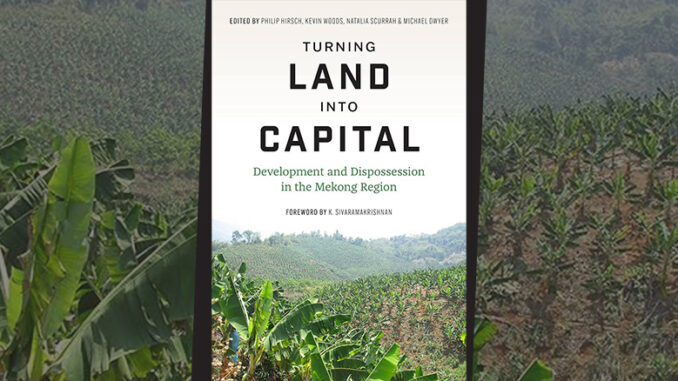
Title: Turning land into capital: Development and dispossession in the Mekong Region
Editors: Philip Hirsch, Kevin Woods, Natalia Scurrah, & Michael B. Dwyer
Publisher: University of Washington Press (2022)
“Turning Land into Capital” examines the contemporary dynamics of agrarian development and dispossession in Thailand, Myanmar, Cambodia, Laos and Vietnam. This edited volume shines a spotlight on land capitalization, which the editors define in a Marxian sense as the various ways in which value in land is mobilized and—at the same time—land is used to mobilize value. Capitalization, as interpreted here, refers to all the actions and social relations through which land becomes a part of wider networks of economic value, involving a wide variety of stakeholders including governments, smallholders, large landholders, and other entrepreneurs.
The editors examine three forms of capitalization. The first is land improvement, which is a social process whereby individual farmers use various means to access and use inputs such as fertilizer, seeds, pesticides, and machinery on their land, as a basis for (claiming or expanding their) ownership. The editors point out that improvement aligns closely with many indigenous notions of land ownership around the world as well as European (Lockean) traditions of “mixing land with labor”. The second form of capitalization is commodification, which involves turning land into a tradeable or mortgageable good, with monetary value. The third—financialization—is a more recent form of capitalization, which sees growing institutional ownership of land by the financial sector, including banks, pension funds, hedge funds, private equity investors, institutional endowment funds, and various kinds of sovereign wealth funds. In these cases, land is typically held as a portfolio asset for the rents that it yields[1].
The edited volume consists of three parts. The first four chapters explore the regional context of land governance, while the second part comprises country chapters exploring how land capitalization plays out in the five countries in the sub-region. In the concluding part the editors tie the observations together, providing a regional perspective.
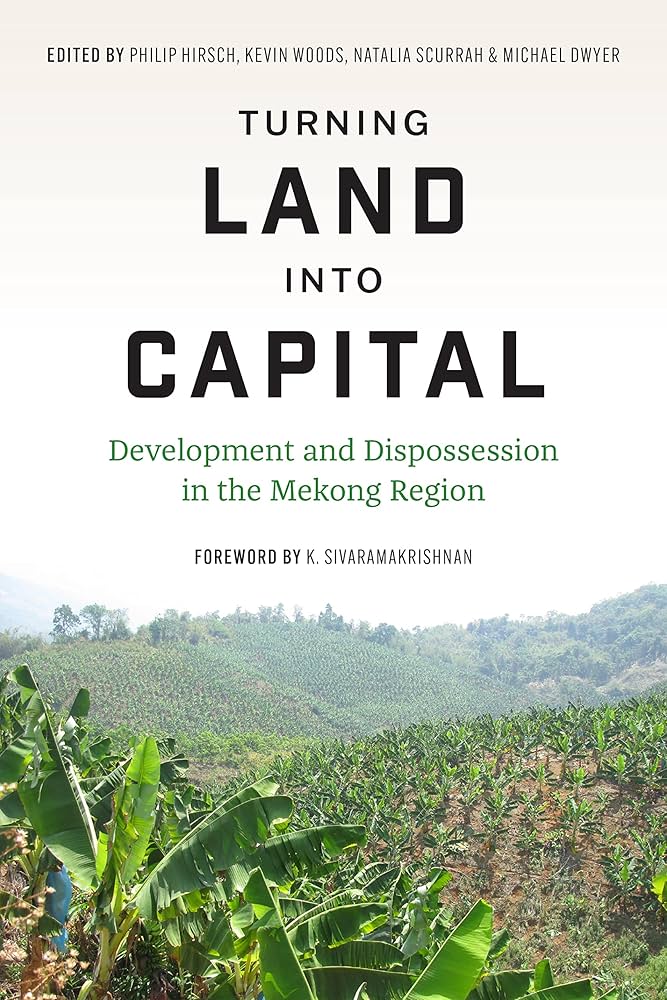
This is an important book. For students and experienced researchers of land governance in Southeast Asia alike, “Turning Land into Capital” provides a valuable update of recent developments in land markets in the region. Precisely because land capitalization these days is a global phenomenon with many local characteristics, the edited volume format is a strength, for the book combines insightful evidence and local context from the five country chapters with excellent broader analysis in the introductory and concluding chapters that provide the regional context, with common themes being the legacies of colonialism and socialism (for Cambodia, Laos, Vietnam, and Myanmar, at least), geopolitical currents, and an enthusiastic neoliberal justification for land capitalization (in all five countries).
Another reason why this book is important is because the authors attempt to present an account of land capitalization that is different from the standard narrative on “global land grabbing”, which portrays transnational capital as aggressively pushing for control over farmland in the global South in a uniform manner. Rather, the editors advance a more nuanced picture, where there is a multiplicity of actors, interests, and struggles and a variety of local capitalization mechanisms and contexts. In their own words, this is a “diverse terrain of struggle that demands to be examined from a variety of perspectives”. Finally, by considering how regional land capitalization approaches play out in other parts of the world, the editors make a valuable contribution to comparative analyses of land governance.
Having said that, the book also lacks some nuance in that the response of communities to the capitalization going on around them is largely ignored. Most of the chapters consider smallholders and civil society as actors who must undergo capitalization but their role as agents of the processes going on around them is given less attention. How do these actors try and shape these processes to their own benefit? Are they always bound to be losers from the capitalization actions taking place? Only the Thailand and Vietnam country chapters conclude that smallholders can put up resistance and sometimes emerge as winners, whether as beneficiaries of the Land Titling Program or in accommodations with the state as part of the ‘territorial compromise” between the state and the peasantry[2], or in pushing for modifications to legislation to better protect their interests. Moreover, smallholders and civil society groups tend to be portrayed as a monolithic block. While there is some acknowledgment that civil society leaders can be “at odds” over the give and take of development and dispossession (i.e., with the example of the Dawei SEZ in Myanmar), it is a pity that not more attention is paid to the internal struggles these players face in coming to grips with capitalization forces. For example, while it is correct that the Land Management and Administration Project (LMAP) in Cambodia was an “exclusionary process” in that it failed to benefit many households who were vulnerable to eviction in Phnom Penh in the early 2000s[3], it is also true that many of those households were benefiting at that time from urban social land concession projects organized by the state. The winners of those schemes tended to be community leaders and entrepreneurial households who managed to rig the system and (illegally) buy up multiple rights at the expense of other community members[4].
The geographical identification of the sub-region covered as the “Mekong region” is a bit puzzling. The focus of the discussions—including southeastern Myanmar and southern Thailand, for example—goes much beyond the Mekong River basin. While the term “Mekong region” is used occasionally by development reports to refer to the sub-region, in this book use of the term implies a common history (i.e., post-socialist, post-conflict and perhaps post-colonial) that is not there, with the inclusion of Thailand as an outlier on all three counts, and even Myanmar (still in conflict as we speak). While recognizing that any geographical term will always be inadequate, could “mainland Southeast Asia” not have been a more suitable term to describe the regions covered?
These are just minor quibbles, however. “Turning Land into Capital” is a critical piece of scholarship that demonstrates that capitalization in contemporary mainland Southeast Asia often represents a form of reverse land reform that goes hand in hand with inequality of access to land across the region, albeit with different local properties and due to different local causes.
Reviewed by Paul Rabé
Lead Specialist, Urban Land Governance, Institute for Housing and Urban Development Studies (IHS), Erasmus University Rotterdam
Notes –
[1] Citing Harvey, D. (2018). The limits to capital. Verso books.
[2] Citing De Koninck, R. (1996). The peasantry as the territorial spearhead of the state in Southeast Asia: the case of Vietnam. Sojourn: Journal of Social Issues in Southeast Asia, 231-258.
[3] Citing Grimsditch, M., and N. Henderson (2009). Untitled: Tenure insecurity and inequality in the Cambodian land sector. Bridges Across Borders Southeast Asia, Centre on Housing Rights and Evictions, and Jesuit Refugee Service, Phnom Penh and Geneva.
[4] Citing Rabé, P. E. (2009). From “squatters” to citizens? Slum dwellers, developers, land sharing and power in Phnom Penh, Cambodia. University of Southern California.