

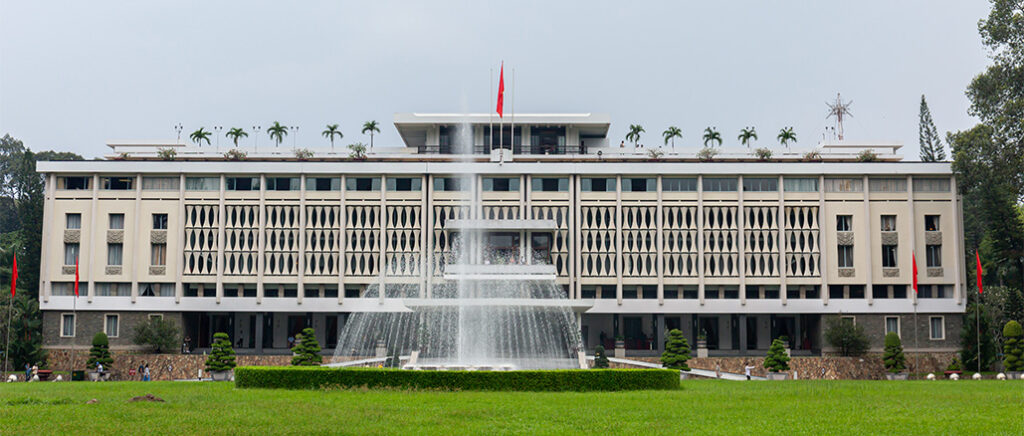
Fifty years ago, an education system in South Vietnam took its last breath, along with the republic it belonged to. For many who grew up in its classrooms, the Republic of Vietnam’s (RVN) education was something “golden” and “full of regret”. Some social media channels in Vietnam today, particularly anti-government ones[1], reflect on the RVN in general and its education in particular with a strong nostalgia. Using visual and audio archives, the nostalgia that arises portrays the past in romanticized retrospection. RVN’s education, by these media, was apolitical, free, and unbiased—a “nền giáo dục phi chính trị”—across and beyond the contemporary turbulent political cross currents. The memory-keepers extol the supposed political neutrality of the era’s education but often conveniently overlook a truth: education can never escape the political realities of its time. Every curriculum, every textbook, every classroom interaction inevitably breathes under the political atmosphere of its time. The myth of neutrality becomes, ironically, a political act itself. The idealization of the RVN’s education system is a rose-tinted retrospective that polishes historical complexity into a simpler, more comforting narrative.
Introduction
Critics like Đương (2021) and Trần (2014) argued that education under Republic of Vietnam was apolitical. This view likely emerges as the RVN’s government exercised less control over their educational system, and classrooms in the South were more open to different ideas compared to the North with heavy influence from the Communist ideologies. However, this discussion challenges the notion of apoliticalism by demonstrating that, like in all educational systems, politics—executed with subtlety—was embedded in the RVN’s education system. Drawing on Benedict Anderson’s theory on nationalism, the analysis will unveil the inherently political nature of what was purportedly an “apolitical” education, by examining the RVN’s educational philosophy—a subject frequently cited in discussions on this topic (Trần, 2014; Nguyễn, 2019; Theo Dấu Giày Sô, 2022, 2023; VOA Tiếng Việt, 2017, 2019; Little Saigon, 2020)—along with its subject curriculum, textbooks, and some policies.
A common ground
Education is just one of the countless contrasts between North and South Vietnam due to political division. Following Marxism-Leninism philosophies, the DRV’s (Democratic Republic of Vietnam, the Communist North) education system, according to Huỳnh (2021b), writing in Luật Khoa tạp chí—a journal known for its anti-Communist Party of Vietnam stance—was characterized as one “for combat”, with political missions deeply embedded and teachers reduced to mere “teaching automatons” (thợ dạy). In contrast, the Republic of Vietnam’s (RVN, the non-Communist South) education system was described by Huỳnh as “free,” “apolitical,” and focused on “education for life’s sake” (vị nhân sinh), though “fragmented” and “messy”. While the political division between North and South Vietnam created two education systems with distinct characteristics, they shared a key ideological principle, which will be examined in the following section.
Both regimes adhered to their own educational principles to guide their nations. The DRV adhered to principles of Popular Education (Đại chúng hóa), Nationalism (Dân tộc hóa), and Scientific Approach (Khoa học hóa), while the RVN promoted Humanism (Nhân bản), Nationalism (Dân tộc), and Liberalism (Khai phóng). These principles served as foundational directives for education under each regime. Even at the university level in the RVN, where institutions enjoyed considerable autonomy, these principles remained among the few mandatory guidelines that the academic system had to follow (BBT, 2021). Notably, both systems shared one fundamental principle: “Nationalism”. The table below summarizes the interpretations of the “Nationalism” principle for both the DRV and the RVN during the period 1955–1975[2]. This common ground will be shown to have undermined the claim of apoliticism, exposing it as both naive and biased. Indeed, no educational framework can be completely divorced from political influence, including RVN’s.
| Democratic Republic of Vietnam (DRV) | Republic of Vietnam (RVN) |
|---|---|
| Dân tộc hóa (Nationalism): Focuses on opposing foreign cultural influences that could degrade national independence and sovereignty. It aims to maintain and directly serve the nation’s interests, honor its history, take pride in its national identity, and take responsibility for national liberation and development of a new national culture. | Dân tộc (Nationalism): Respects the values of an independent country, the unique traditions of the nation in all activities related to family, profession, and country. Education must express, preserve, and promote the essence of national culture to prevent its loss or dissolution into other cultures. Education also aims to ensure national unity and longevity, along with harmonious and comprehensive development. |
Contested Nationalism
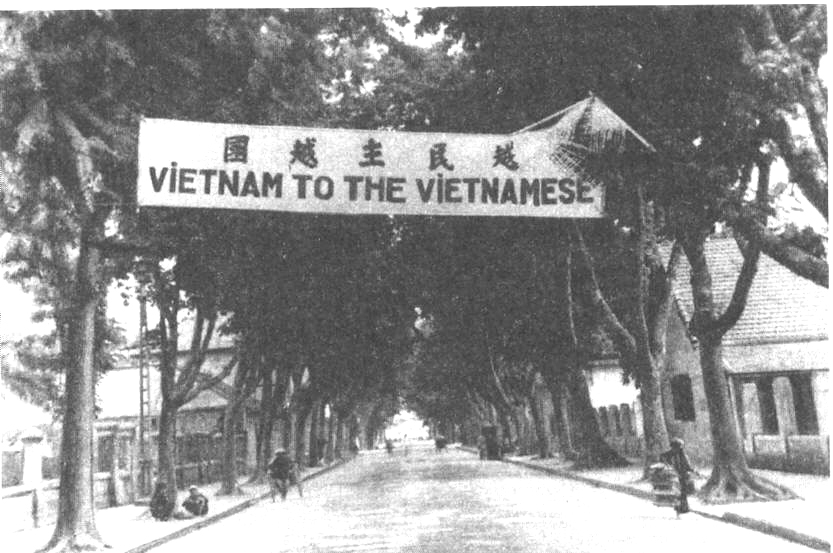
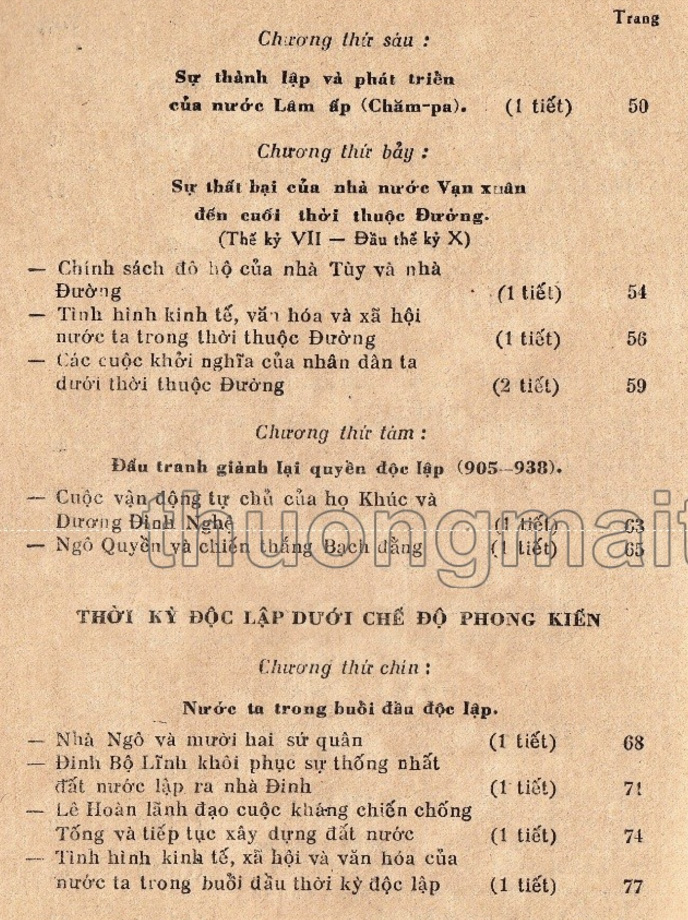
The unique geopolitical context of the RVN and DRV gave rise to what scholars have termed “Contested nationalism” (Tran, 2012). Both regimes asserted that their “nationalism” was the sole authentic representation of Vietnamese culture and by teaching nationalism, patriotism, each state was claiming authentic nationalist and political legitimacy. The “Nationalistic” principle was particularly pronounced in subjects like History and Geography across both the RVN and the DRV. Below are example pages from History textbooks used in the RVN and the DRV. Both sides, while ideologically divided, shared a common theme of resistance, with History curriculum textbooks featuring conflicts with foreign powers such as China, France, and Japan.
RVN History curriculum textbooks:
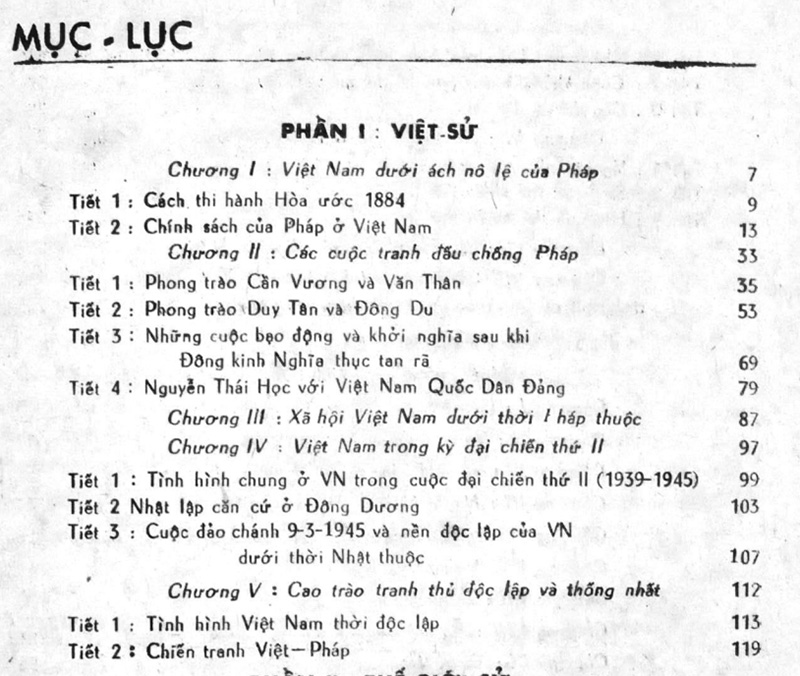
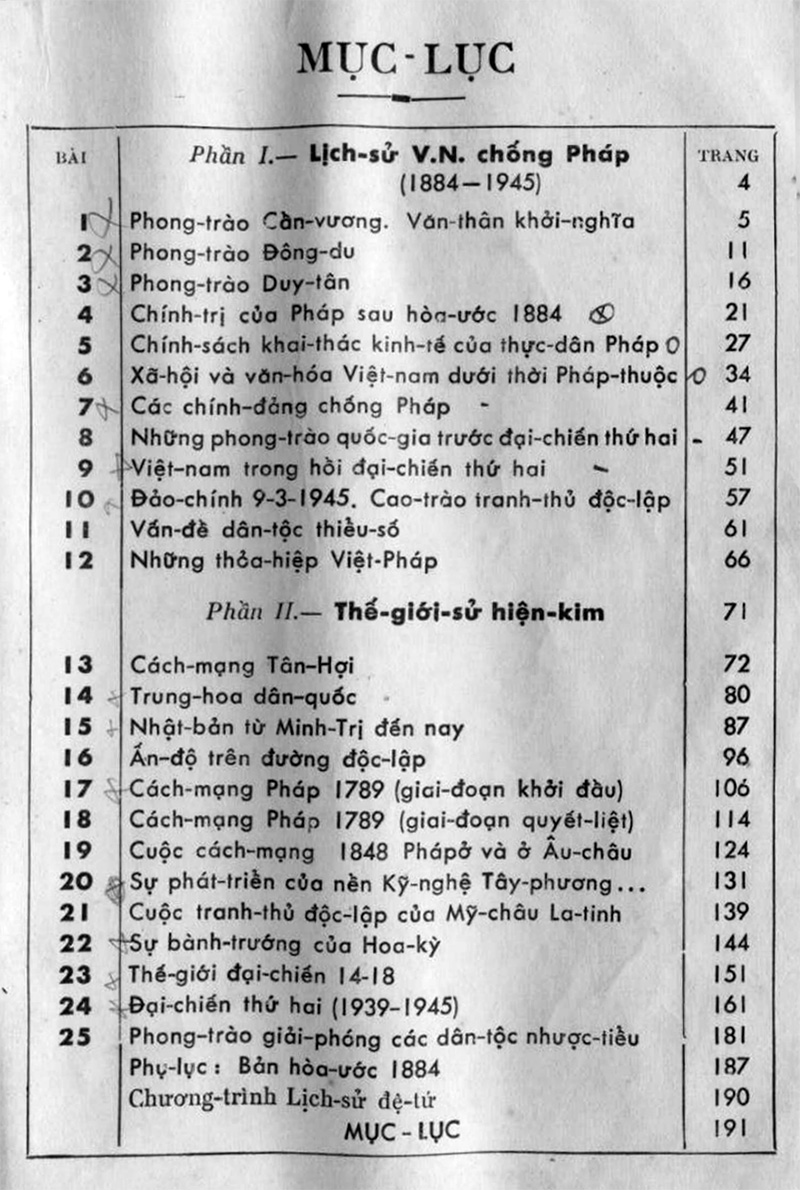
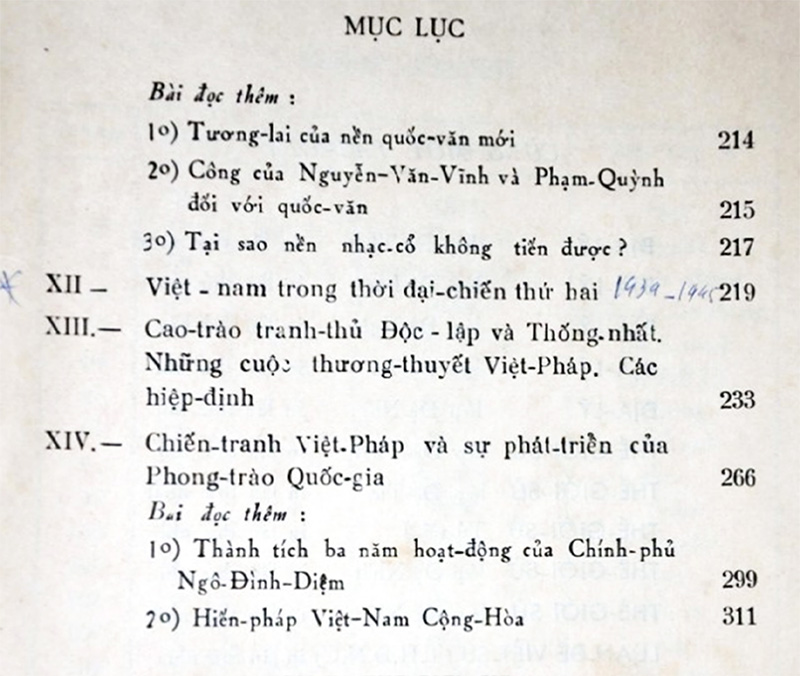
(Tăng, 1959)
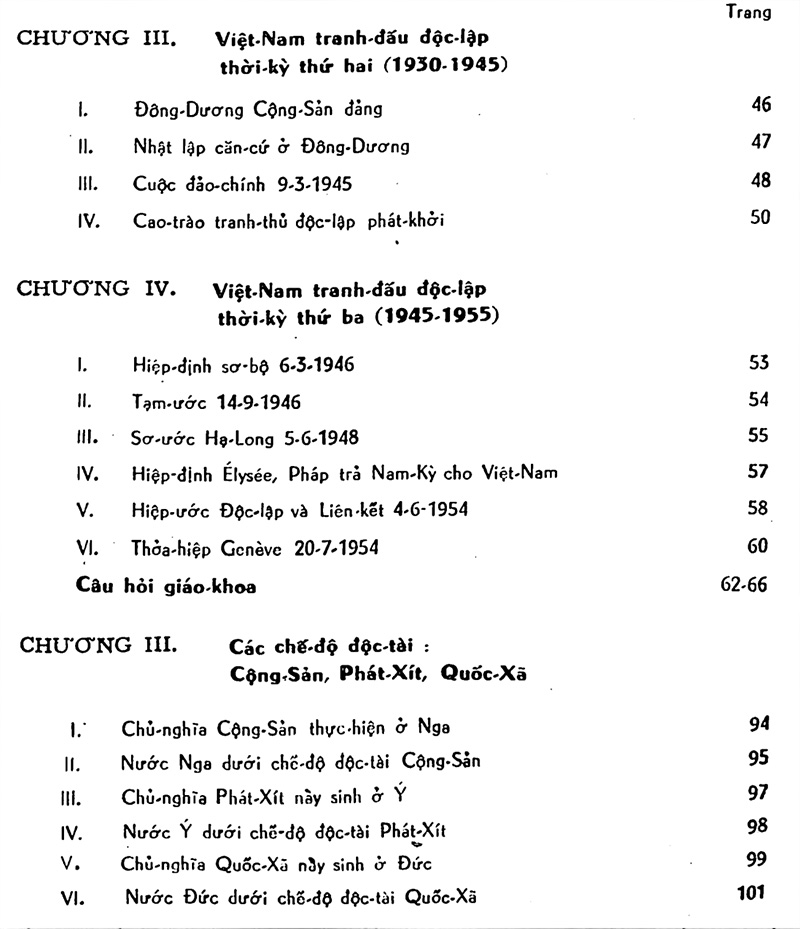
DRV History curriculum textbook:

The RVN society was a diverse society fractured by complex social and ideological divisions. Its population comprised individuals from vastly different backgrounds and histories: “old Vietnamese” who came from the North, “new Vietnamese” of the Central Highlands (miền Thượng) that were only integrated into the Vietnamese identity in the 19th century (they are known as Montagnard), and various other ethnic and religious communities. The multilingual and multireligious nature of the society, which included speakers of different dialects and adherents of Buddhism, Catholicism, Hoà Hảo, and Cao Đài, posed significant challenges in reaching a consensus. Yet, like a large family whose internal conflicts might be transcended when confronting an external threat or a common enemy, the narrative “to be Vietnamese is to fight against foreign aggression” became an important and powerful unifier to the RVN. It is in these life-and-death struggles that bonds are forged. In wars, people set aside their differences as strangers become comrades. The very concept of “being Vietnamese” became intrinsically linked with a nationalist sentiment that sought to bridge the society’s diverse communities, though the vision was not universally embraced[3]. By emphasizing shared historical experiences of national resistance, the education system worked to forge a sense of collective belonging that mirrored the national identity prevalent in the North, while according to Tran (2012, p. 11) “tied Vietnamese ethnic identity to state power”.
In geography education, the RVN also used the subject as a tool to construct national identity during the period of intense competition between North and South Vietnam. Some example RVN Geography textbook pages below provided descriptions of the country that included the north and portrayed Vietnam as a singular, uninterrupted territory from north to south, omitting any reference to the political division marked by the demilitarized zone between the RVN and the DRV (Tran, 2012). The RVN national curriculum required students to study even the geography of northern areas controlled by the DRV (Tran, 2012). Maps used in these textbooks often excluded any indication of the RVN or DRV as distinct entities and instead showed transport routes and physical features that suggested an interconnected and whole nation (Tran, 2012). These geographically seamless visions of Vietnam shaped learners’ perceptual understanding of national territory and further challenged the political realities of division. By teaching about all of Vietnam’s regions, the RVN showed that they considered the entire country as part of their patrimony. It was their attempt to assert claims over the entire Vietnamese territory while contesting the DRV’s authority over the North.

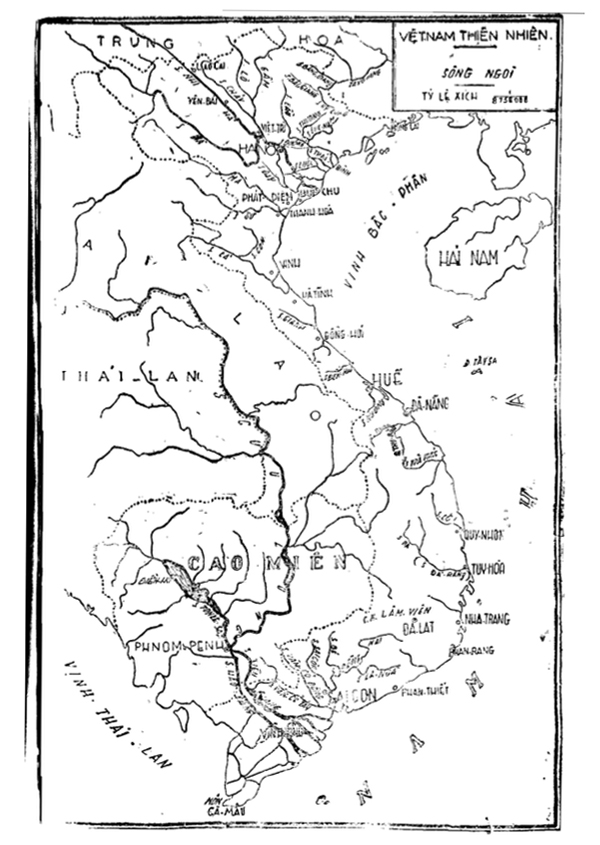
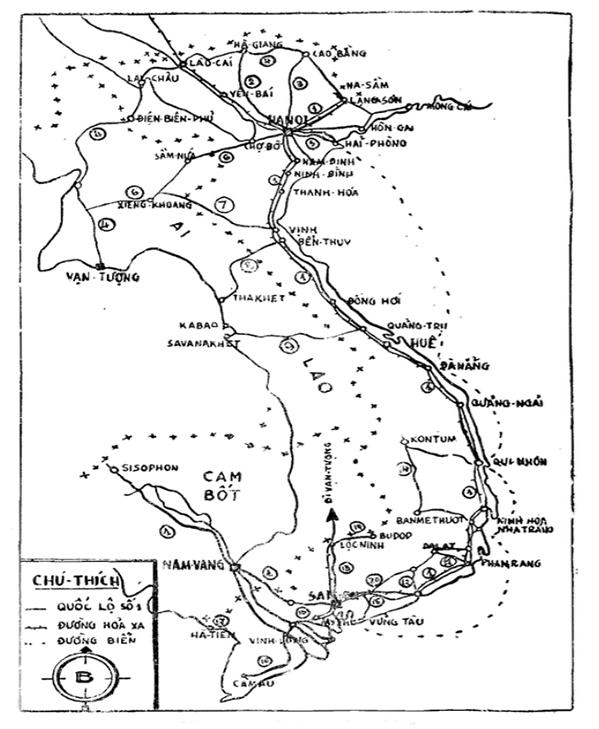
Nations, according to Benedict Anderson (2006), are “imagined political communities” with finite boundaries that are created through shared symbols, narratives, identities, and cultural practices. These “imagined communities” consist of groups who see themselves as part of a collective. Nationalism, according to him, “has to be understood by aligning it, not with self-consciously held political ideologies, but with the large cultural systems that preceded it, out of which—as well as against which—it came into being” (Anderson, 2006, p. 12). Nationalism is not just about the political beliefs or explicit ideologies that people might openly express or discuss. Nationalism is deeply rooted in the wider cultural contexts that subtly shape how people think about their identity and belonging, often without them being fully aware of it. In this process, education plays a critical role. Schools, standardized language, shared history form a collective identity, foster a sense of belonging to the national “imagined community”, and evoke strong feelings like proud, loyalty, sacrifice, or even hostility. These elements tap into the deep-seated human needs for belonging and significance. They make people love and die for nations. Benedict Anderson (2006) emphasized that nationalism not only arises from these cultural systems but also, in some cases, reacts against them. In the case of Vietnam, nationalism developed both from its cultural heritage and in opposition to “foreign powers”. The latter is what makes people hate and kill for nations.
But why does nationalism matter to a country? Because it is essential for state-building. RVN’s national objectives—specifically its state-building project—as articulated in the 1967 Constitution, aimed to “establish a republican form of government of the people, by the people and for the people whose purpose is to unite the nation, unite the territory and assure independence, freedom, and democracy with justice and altruism”.
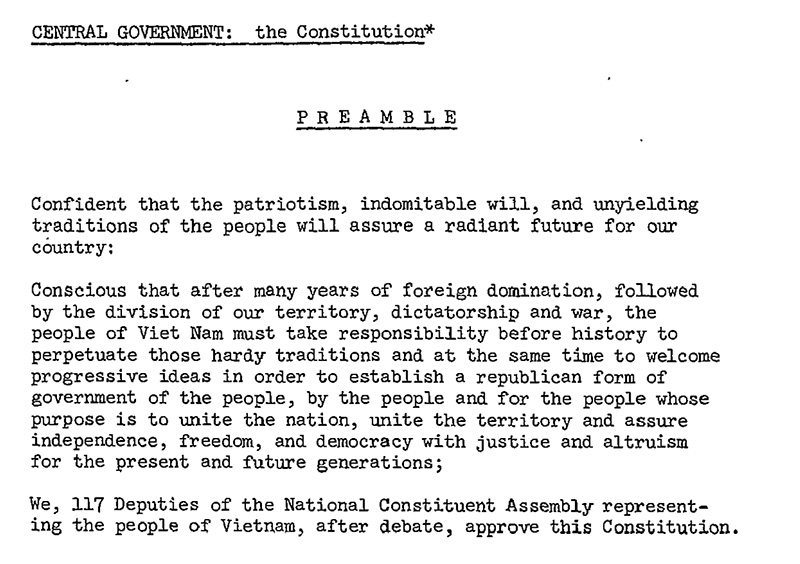
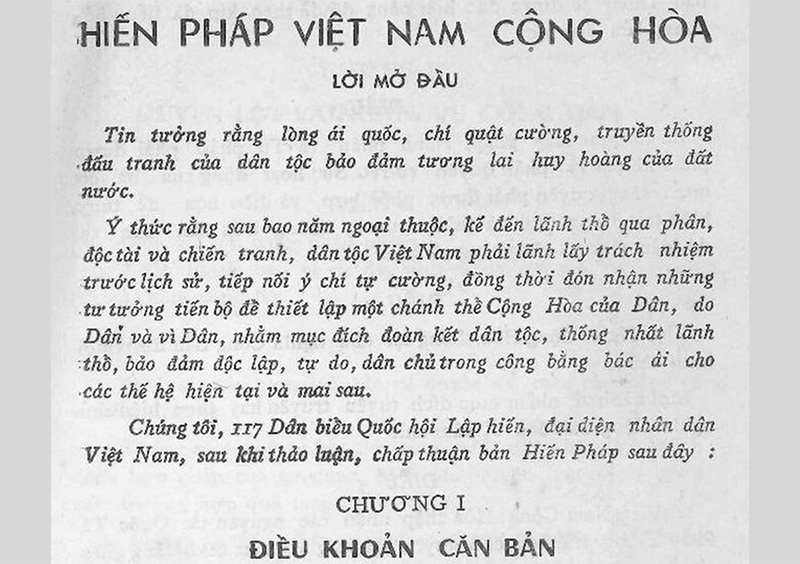
The “nationalism” educational philosophy directly reflected and supported the visions declared. Education helps deliver these visions. By having a populace that identifies strongly with its nation, the government of the Republic of Vietnam could forge a unified community capable of working towards common goals and defending national interests. Nguyễn Đình Hoà, former Chairman of the UNESCO Social and Cultural Committee of the RVN government, explicitly stated in 1965: “Higher education in Vietnam has a definite objective of training sufficient cadres and technicians for all branches of national development” (Nguyen, 1965, p. 30). Through schooling, students are systematically socialized into a specific civic identity and trained to serve the state’s needs. The process of standardization creates a shared foundation of values and knowledge that binds citizens together. Teaching love for the country, the “nationalism” embedded in Geography and History subjects in the Republic of Vietnam exemplifies how schools can be powerful instrument for cultivating national consciousness and social cohesion. From here, it is apparent that education under RVN, like all education systems, was to serve its regime and function to support a coherent society. In order to do so, “Nationalism” was a key theme.

.png)
A political act itself
One key educational goal declared in the RVN’s 1st National Education Congress in 1958 was to “provide students with complete information for them to judge and choose; do not conceal information or selectively provide dishonest information according to any predetermined policy or direction” (Nguyễn, 2006). Some critics who attended RVN’s schools, such as Thuỵ Khuê in Văn học miền Nam (as cited in Trần, 2014), also insist on this notion of neutrality, suggesting that history and literature in South Vietnam were taught comprehensively and without bias. Trần (2014, p. 48) similarly argued that “in History, all historical figures and events were included and evaluated objectively, rather than following any class-based standpoint, with criticism primarily based on patriotism and rationality.”
However, the very act of creating an “inclusive” historical narrative was to foster a Vietnamese identity that sought to unify the fragmented society under one national framework—one that was different from its Northern brother. “Criticism primarily based on patriotism” explicitly reveals how historical interpretations were filtered through a nationalistic prism. The claimed objectivity—presenting “complete information” for students to “judge and choose”—is also problematic. To assert that subjects like History can be neutral is to suppose we can view the world unbiased by our context or culture. As postcolonial theorist Partha Chatterjee (1986) argues, historical narratives are intrinsically constructed through specific political, cultural, and ideological lenses. It is the selectivity of knowledge that makes historical narratives never politically neutral.
Similar to Trần’s (2014) perspective, Nguyễn Văn Phú, a professor during the RVN regime (as cited in Q. G. Nguyễn, 1970) asserted that their education was separated from politics: “We do not wish to implement our political intentions in schools. We only cultivate patriotic souls, we only prepare children for life.” Nguyễn Văn Phú and Q. G. Nguyễn failed to recognize the intrinsically political nature of patriotism. Educating love for the country transcended simple educational objectives. It was that patriotism that pushed the young men to the war front, driving them to fight and sacrifice their lives against individuals of their same ethnic background, all in the name of protecting the South Vietnamese nation-state.
This relationship between education and culture is crucial: More than containing institutions of learning, the education system’s various parts are also arenas of cultural and ideological contests. Paulo Freire articulates in The Politics of Education (1985, p.17): “Culture, in this view, obscures the ideologies that legitimize and distribute specific cultural forms as if they were detached from ruling-class interests and existing power configurations,” indicating that educational content and practices are not neutral but are designed to perpetuate certain ideologies. Paradoxically, it reveals how deeply politics is embedded in educational systems, even when—and perhaps especially when—they claim to be apolitical.
Selective inclusivity
Trần (2014) argued for the education system in the RVN’s apolitical nature by pointing out that the system allowed those who opposed the regime to participate in academic examinations. He noted, “Even those who were imprisoned for expressing opposition to the Republic of Vietnam regime were still allowed by educational authorities to form special examination committees, and if they passed, they would receive their diplomas right in the prison” (Trần, 2014, p. 47). Similarly, Hoàng Đức Nhã (2019, p. 60) highlighted the abundant resources within the RVN’s education system, including “scholarships for gifted students to be trained at overseas universities produced a class of well-trained technocrats who were critical to the success of our nation-building efforts.” While students and educators were seemingly granted extensive opportunities to study and train in the West to contribute to national development, these opportunities were not equally distributed. Such opportunities did not work the same way for those opposing the RVN regime. Students studying abroad were subject to background checks by authorities for potential restrictions if their relatives were identified as communists (Trần, 2014). The background checks were a form of political control, limiting educational opportunities based on ideological affiliations. Such practice shows how the educational system’s claims of neutrality were undermined by its own policies.
Conclusion
This essay counters the idea that RVN’s education was exceptional in being apolitical. RVN officials and practitioners were unable to consider patriotism as being a part of politics. I argue that all education systems are subject to the political realities of their time, and the RVN was no exception—just in a more subtle way. Its education was a dynamic entity shaped by the political landscapes it existed within. Sometimes, ideological formation occurs not only through overt propaganda but also through subtly constructed narratives of national identity, shared values, and collective purpose.
Some anti-Communist-Party-of-Vietnam media sometimes downplay these complexities. They prefer to depict their old regime’s education system in an overly favorable light as more special, apolitical, and different from the North. By draping it in the rhetoric of objectivity and creating a contrast by placing it next to the explicitly political education in the North, these critics elevate the RVN while diminishing the DRV. Thus, the very act of claiming neutrality is, ironically, a political act itself—a subtle rewriting of historical complexity into a more comfortable memory. Such idealization reflects a rose-tinted view that smooths historical intricacies. It is a reminder that nostalgia often says more about present desires than past realities.
Linh K Chau
VinUniversity, Hanoi
Acknowledgement
I would like to express my profound gratitude to my supervisor, Professor David WH Koh, whose patient support and guidance have been instrumental in the completion of this paper. His thoughtful feedback and critical perspectives that challenged my thinking while providing generous mentorship have been invaluable. His mentorship extended beyond academic guidance, and this paper would not have been possible without his support. I am deeply grateful for the time he dedicated to reviewing drafts, providing detailed comments, and engaging in meaningful discussions that expanded my research horizons.
I also extend my sincere appreciation to Historian Dinh Kim Phuc, whose insights and expertise provided valuable perspectives on the realities of South Vietnam’s education system and greatly enriched my understanding of the period. Additionally, I am grateful to the faculty members at VinUniversity who have shaped my academic journey. In particular, I acknowledge Professor Jason A Picard, whose History class deepened my understanding of ethnic Vietnamese identities and whose early discussions on this topic, though not directly reflected in my final arguments, were intellectually enriching.
References–
Anderson, B. (2006). Imagined communities: Reflections on the origin and spread of nationalism. Verso.
BBT. (2021, June 11). Lê Xuân Khoa: Đại học miền Nam trước 1975: Hồi tưởng và nhận định. Thư Viện Phật Việt. https://thuvienphatviet.com/le-xuan-khoa-dai-hoc-mien-nam-truoc-1975-hoi-tuong-va-nhan-dinh/
Chatterjee, P. (1986). Nationalist thought and the colonial world: A derivative discourse. Zed Books.
Durkheim, É. (1956). Education and sociology. Simon and Schuster.
Freire, P. (1985). The politics of education: Culture, power and liberation. Praeger.
Hiep_Khach_VN. (2023). Một số hình ảnh sách giáo dục của 2 miền Nam Bắc trước năm 1975 [Photograph]. Tinh tế.
Hoàng, Đ. N. (2019). Little Saigon. (2020). Nền giáo dục VNCH – Nhân bản, Dân tộc và Khai phóng. NW Vietnamese News. https://nvnorthwest.com/2020/04/nen-giao-duc-vnch-nhan-ban-dan-toc-va-khai-phong/
Lê, K. N. (1969). Sử-Địa Đệ-Nhất A.B.C.D. Văn Hào Saigon.
Little Saigon. (2020). Nền giáo dục VNCH – Nhân bản, Dân tộc và Khai phóng. NW Vietnamese News. https://nvnorthwest.com/2020/04/nen-giao-duc-vnch-nhan-ban-dan-toc-va-khai-phong/
Nguyen, D. H. (1965). Higher education in the Republic of Vietnam. Saigon, Vietnam: Directorate of Cultural Affairs, Ministry of Culture, Department of Cultural and Social Affairs.
Nguyễn, H. P. (2019). The philosophies and development of a free education. In T. Vu & S. Fear (Eds.), The Republic of Vietnam, 1955–1975: Vietnamese Perspectives on Nation Building (pp. 93-103). Cornell University Press.
Nguyễn, Q. G. (1970). Cải tổ giáo dục. Thăng tiến xuất bản, Sài Gòn.
Nguyễn, T. L. (2006). Giáo dục ở miền Nam tự do [Education in free South Vietnam]. Santa Ana, CA: Le Van Duyet Foundation.
Striving for a Lasting Peace: The Paris Accords and Aftermath. In T. Vu & S. Fear (Eds.), The Republic of Vietnam, 1955–1975: Vietnamese Perspectives on Nation Building (pp. 57-69). Cornell University Press.
Tăng, X. A. (1959). Việt Sử Lớp Đệ Nhất. Tao Đàn Xuất Bản.
Tăng, X. A. (1963). Map 3. “Việt Nam Thiên nhiên” (Physical Map of Vietnam). In Địa lý Việt Nam lớp đệ nhị lớp A, B, C, D (p. 45). Sống Mới. As cited in Tran, N.-A. (2012). Contested nationalism: Ethnic identity and state power in the Republic of Vietnam, 1954-1963. UC Berkeley ISSI Fellows Working Papers. https://escholarship.org/uc/item/1kb72zvh.
Tăng, X. A. (1963). Map 4. “Việt Nam: Đường giao thông” (Roadmap of Vietnam). In Địa lý Việt Nam lớp đệ nhị lớp A, B, C, D (p. 44). Sống Mới. As cited in Tran, N.-A. (2012). Contested nationalism: Ethnic identity and state power in the Republic of Vietnam, 1954-1963. UC Berkeley ISSI Fellows Working Papers. https://escholarship.org/uc/item/1kb72zvh.
Theo Dấu Giày Sô. (2022). Nhìn lại nền “GIÁO DỤC VNCH” – Sự tiếc nuối vô bờ bến | Góc hoài niệm xưa [Video]. YouTube. https://youtu.be/RUKE91-S0Bo?si=fRZCaHBEHrukh-yA
Theo Dấu Giày Sô. (2023). Nền giáo dục khai phóng của VNCH có gì đặc biệt? [Video]. YouTube. https://youtu.be/1lIqhbqJiBo?si=85CA7UNjfexr3sHd
Thu, P. (n.d.). Đề cương văn hóa việt nam 1943: Văn kiện lịch sử có ý nghĩa đặc biệt quan trọng với cách mạng và con đường vận động, phát triển của nền văn hóa mới việt nam. Trường Đại Học Khoa Học Xã Hội và Nhân Văn — Đại Học Quốc Gia Thành Phố Hồ Chí Minh. Retrieved December 13, 2024, from https://hcmussh.edu.vn/news/item/24303?
Trần, H. Q. (1959-1960). Việt-Sử và Thế-Giới-Sử Lớp Đệ-Tứ. Nguyễn-Du Xuất-Bản. https://txawriter.wordpress.com/wp-content/uploads/2021/09/lichsu-vn-thegioilop-detu-1959.pdf
Tran, N.-A. (2012). Contested nationalism: Ethnic identity and state power in the Republic of Vietnam, 1954-1963. UC Berkeley ISSI Fellows Working Papers. https://escholarship.org/uc/item/1kb72zvh
Trần, V. C. (2014). Education in the South of Vietnam (1954-1975) on the path of building and development—Giáo dục miền Nam Việt Nam (1954-1975) trên con đường xây dựng và phát triển. Tạp Chí Nghiên Cứu và Phát Triển , số 7-8(114–115).
VOA Tiếng Việt. (2017). Giáo dục: Bao giờ được như…xưa? [Video]. YouTube. https://youtu.be/d-uykINFm2I?si=cgZJIB8YTDZLNMob
VOA Tiếng Việt. (2019). Giáo dục Việt Nam Cộng hòa không phục vụ chiến tranh [Video]. YouTube. https://www.youtube.com/watch?v=1yc_QQCQw0M
Đỗ, Q. C. (1966-1967). Toát Yếu Việt-Sử – Thế-Giới-Sử Địa-Lý Đệ Nhất ABCD. Dương Sáng Xuất-Bản.
Huỳnh, C. Đ. (2021a). Giáo dục Nam – Bắc Việt Nam – Kỳ 1: Nền tảng và khác biệt. Luật Khoa tạp chí. https://www.luatkhoa.com/2021/04/giao-duc-nam-bac-viet-nam-nen-tang-va-khac-biet-ky-1/
Huỳnh, C. Đ. (2021b). Giáo dục Nam – Bắc Việt Nam – Kỳ 2: Từ “thợ dạy” đến “tự do cá nhân.” Luật Khoa Tạp Chí. https://www.luatkhoa.com/2021/04/giao-duc-nam-bac-viet-nam-ky-2-tu-tho-day-den-tu-do-ca-nhan/
Notes –
[1] See, Theo Dấu Giày Sô (2022), VOA Tiếng Việt (2017, 2019), and Huỳnh (2021a, 2021b) in “Luật Khoa Tạp Chí” for nostalgic perspectives on RVN’s education. These media sources are considered to be anti-Communist-Party-of-Vietnam government. Full references can be found in the reference list.
[2] The interpretation of these principles is drawn from the Outline of Vietnamese Culture—Đề cương về văn hóa Việt Nam (Thu, n.d.) for the DRV, and for the RVN through sources from Nguyễn Thanh Liêm—former Deputy Minister of Culture, Education, and Youth during the Second Republic (The Second Republic of Vietnam, lasting from 1967 to 1975, was led by President Nguyễn Văn Thiệu) (Nguyễn, 2006)—and Nguyễn Hữu Phước—a former student of the RVN education system and later lecturer at the College of Education, Saigon University (Nguyễn, 2019).
[3] While this nationalist sentiment served as a unifying force for many, it did not necessarily reflect the aspirations of all ethnic groups. Some minorities, such as the Montagnards, had distinct political goals and, in some cases, actively resisted the South Vietnamese government (e.g., FULRO’s rebellion in 1964).