


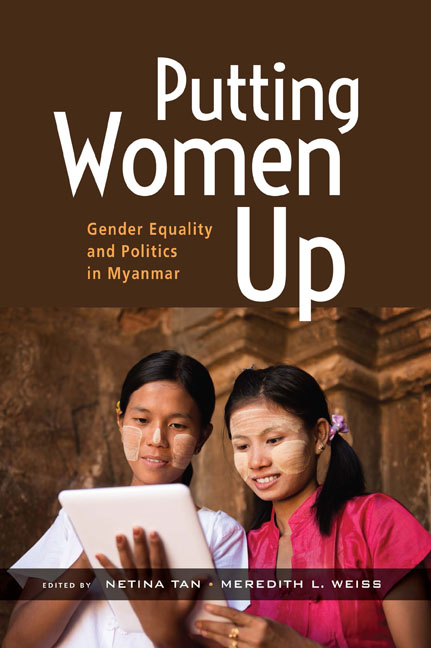
Title: Putting Women Up: Gender Equality and Politics in Myanmar
Editors: Netina Tan & Meredith L. Weiss
Publisher: ISEAS – Yusof Ishak Institute, (2024)
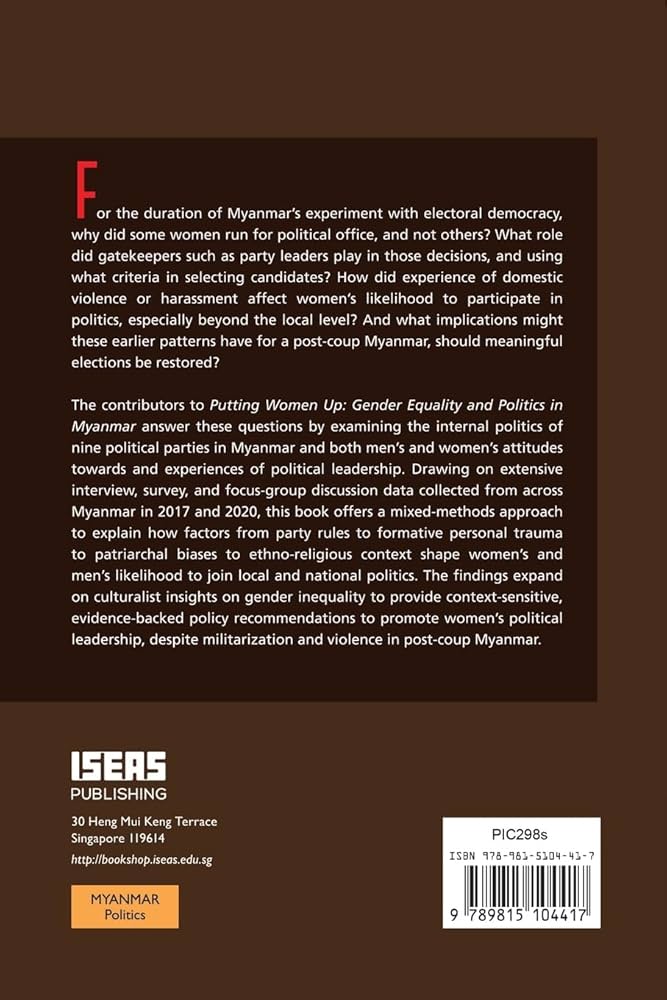
This is a much-needed book that examines women’s participation in Myanmar politics, focusing on women and men’s different opportunities and challenges in securing election at national and subnational levels. Based on a three-year (2017-2020) research project conducted by a team of academics in collaboration with the Enlightened Myanmar Research Foundation (EMReF), chapters draw on rich empirical data, including 2,889 surveys in four regions, 99 focus group discussions, and 99 semi-structured interviews, to explore attitudes and structural barriers to women’s leadership. Six chapters focus on party dynamics, public attitudes, gendered violence, and local governance.
In the opening chapter, editors Netina Tan and Meredith Weiss distinguish their approach from existing scholarship, which they characterize as “historical or culturalist” to promise a systematic study of, “the key political parties, their candidate selection methods, and how party organization and leadership affect women’s political participation at the local and national levels (3).” Rich empirical data and investigation into political parties are key strengths of the book, and the editors are right to point out its distinctiveness from existing research. Their analysis effectively highlights the deep entrenchment of institutional structures and socio-cultural norms within families and communities. The findings underscore how these long-standing features persist beyond political shifts, predating the former democratic system and likely enduring beyond the current authoritarian rule. This insight contributes to a broader understanding of how historical and cultural legacies shape governance and social dynamics over time in Myanmar.
The growth of political parties in the 2010s during a period of liberalization seemed to mean more opportunities for women’s participation in politics. The editors review a growing body of work that considers gender in Myanmar politics, especially the important research of the late Dr. Paul Minoletti, a co-author on two of the chapters here, describing existing work on cultural norms and attitudes that prevent women’s leadership and presenting a snapshot of gender in Myanmar parliaments before the 2021 military coup. As Tan and Weiss note, understanding how, and how well, certain aspects of democracy worked during Myanmar’s reform period is not irrelevant; the social and political patterns of this time, including forms of gender inequality, continue to structure politics in the current period, and will likely persist.
In Chapter 2, Aye Lei Tun and Netina Tan give us a glimpse into the “secret gardens” of candidate selection. The authors highlight the importance of political parties in candidate selection as political parties serve as the primary gateway for political participation in Myanmar (independent candidates make up only a small fraction of election participants) and explore the largely opaque and informal nature of intra-party candidate selection in nine selected parties. They argue that parties are gatekeepers which effectively narrow women’s participation into a small pool for the voters to choose and that more personalized (and less institutionalized) parties are likely to nominate candidates from within personal networks, a pattern that especially hinders women.
The authors draw attention to key differences in candidate selection method between institutionalized parties with clear rules on candidate selection and weakly institutionalized parties with informal processes. While parties such as the USDP and NLD had more centralized, exclusive, and formalized candidate selection, smaller ethnic-based parties were more decentralized, inclusive and ad hoc in their candidate selection in 2015 to 2020 elections. The study highlights institutional barriers, including the composition of the selectorate (the group choosing candidates) and the lack of clear, formalized selection rules in many parties. Decentralized selection methods, particularly those involving township-level committee, provide more opportunities for diverse candidates, but these processes were not consistently applied.
Another key point is the gender imbalance in the party leadership. In many cases, selection is highly centralized, with the Central Executive Committees (CECs) playing a dominant role. The male-dominated nature of CEC reinforces gender inequality in candidate selection: male leaders tend to choose candidates like themselves, creating an old boys’ network that excludes women from leadership. Non-political actors such as religious leaders and community leaders (mostly male), also influence candidate selection, further disadvantaging women. Compounding this, political experience was a key selection criterion in party politics, making it harder for new female candidates to enter the field.
The author raised the issues of limited gender quotas and unmet targets on women’s participation (some parties introduced gender quotas such as 30% of women candidates, but most failed to meet these targets). The highlight that women are often placed in unwinnable constituencies, indicating a lack of genuine commitment to gender equality. The authors recommend strengthening gender quotas, having more female representation in CECs and party leadership, capacity building training programs for women and reforming the party candidate selection method to be more transparent and inclusive.
The next chapter, by Jangai Jap and Cassandra Preece, examines the role of ethnic political parties in promoting women’s representation. It investigates whether ethnic parties are more effective than their catch-all counterparts in recruiting female candidates and identifies key structural and cultural barriers that influence women’s political participation. The findings are mixed: while ethnic parties tend to nominate more female candidates, they struggle to support them effectively, leading to lower election success rates.
Building on analysis in the previous chapters, the authors write that many ethnic parties lack formal candidate selection procedures, making it difficult for women to navigate the system and secure nominations. More institutionalized ethnic parties had a higher success rate for female candidates than newer parties, suggesting that party age and democratic commitment are critical factors. Ethnic parties in single-member district systems tend to include more women than those in proportional representation systems, perhaps because the latter allow party elites, who often hold conservative gender biases, to have greater control over candidate selection. Cultural barriers such as social expectations, patriarchal cultural attitudes of the party, lack of institutional support and security concerns in conflict effected ethnic areas as key factors limiting women’s political participation in ethnic parties.
Key to the analysis in this chapter is the comparison between catch-all parties—the USDP and the NLD—and ethnic parties. Yet a direct comparison between these parties and ethnic parties offers limited explanatory power in analyzing women’s participation and performance because of the distinct characteristics of each catch-all party. While women made up 6% of candidates fielded in 2015 by the USDP—a party backed by military generals, their networks, and business cronies—they comprised 14.4% of NLD candidates, which has long been the most influential opposition party and was led by national icon Aung San Suu Kyi. The NLD was the only party that was particularly effective in securing wins for women. Ethnic parties, in contrast, represent a highly diverse political landscape, shaped by unique historical backgrounds, ethnic interests, and regional challenges. Factors such as geographical inaccessibility, security concerns, and limited information further complicate direct comparisons with catch-all parties across all domains. Further research could explore whether NLD’s unique influences across the country were key to wins for women, as well as probing in more depth what factors influence women winning or losing in particular ethnic areas.
Chapter 4, by Anor Mu et al., analyzes survey data to uncover attitudes towards women in political leadership, finding that men were more likely to express political efficacy and more likely to express satisfaction with democracy, while women were less interested in and informed about politics, though both women and men believed women should be able to make their own choices in elections. This chapter also reports tantalizing findings that beg further research, for example that older women were more conservative than younger women, but older men were more progressive than their younger peers. Another fascinating finding: women were more likely than men to believe women should participate in politics, but less likely than men to support their daughter’s political participation. Together these findings paint a picture of women’s political participation as important to women in theory, but not in practice, especially for older women who do not see their own daughters as leaders, or want a life for them that comes with difficulties and risks. The survey also finds some evidence of the intergenerational nature of gender-based violence: men who saw their mothers beaten at home as a child tended to express less support for women’s political participation and gender equality, suggesting they internalized the values of their abusive fathers.
Chapter 5, by Elin Bjarnegård with contributions by an anonymous co-author, deepens this exploration by drawing on qualitative research to consider how party politics and political candidates are affected by and experience violence, from intimate partner violence in the home to militarization on the streets. One important observation from this chapter is that while both male and female candidates experience political violence, the nature of violence is often gendered. The study highlights that women in politics face more personal attacks online and offline including rumors and online harassment with sexualized content. In contrast, male politicians face threats and physical intimidation while women are more likely to encounter psychological and social forms of violence.
The feminist concept of “the personal is political’ is highly relevant in Myanmar, where domestic violence and public political violence are interconnected. The DHS survey (2016-2017) findings show a significant proportion of women in Myanmar justified wife-beating by a husband, with approximately 50% of participants agreeing that a husband is justified in beating his wife in certain situations; this highlights a concerning level of acceptance. Normalizing violence against women at both family level and political level is a key factor deterring women’s political participation.
The study also highlights the lasting impact of generational trauma on women’s political engagement, particularly the long-term effects of violence against women. Women who experienced physical abuse as children are less likely to perceive themselves as capable of participating in politics. Similarly, men who witnessed their mothers being abused tend to show lower support for gender equality in political spaces.
Additionally, the study underscores the differences in family attitudes toward political participation for men and women, shaped by societal expectations of gender roles. While male politicians’ families primarily view lost income as a challenge, women politicians often face familial pressure due to their perceived neglect of household responsibilities, such as caregiving and domestic chores.
While there were growing numbers of women involved in national politics during the reform period, women’s representation in local governance remained extremely low. While women made up almost 14% of elected members of parliament in the national parliament after 2015, they represented less than 1% of elected local administrators. Chapter 6, by Cassandra Preece, La Ring Pausa and Paul Minoletti, draws on focus groups and interviews to identify the barriers to women’s local participation, including time and resource constraints as well as safety concerns. While the extremely low numbers of women in local versus national politics might defy Western expectations, it is consistent with a historical pattern, investigated by scholars including Chie Ikeya (2011) and Tharaphi Than (2013), in which elite women’s success in politics and relative freedom in the eyes of outsiders blinds observers to the ongoing oppression of everyday women and perpetuates the postcolonial myth of the “traditional” high status of women in Burma. Engagement with this historical scholarship could have increased the explanatory power of this book, which has an uncomfortable relationship to culture: while the book starts by rejecting cultural explanations, it ends by including cultural biases on a list of key barriers women face to political leadership.
This opens a door to consider what research on gender in Myanmar might look like if it were to take cultural explanations not as an answer, but rather as an invitation for investigation. We think here of the strong pattern, which goes unremarked on in the book, of widows and daughters rising to political leadership. This is most obvious in the case of Aung San Suu Kyi, but also apparent in the military and in ethnic minority parties and social movements. Asking women leaders about their family histories and political trajectories may yield alternative accounts of how they navigated party politics.
The central argument relies on the assumption that increasing the number of women leaders in politics naturally leads to greater political participation for women and uphold democratic values. However, this perspective raises some questions, as it does not account for the diversity of political stances among women leaders. Our experience in Myanmar in the last decade, some women MPs who, despite their gender, uphold deeply patriarchal, misogynistic, and even exclusionary views. Some have advanced in politics by aligning themselves with highly patriarchal male leaders and reinforcing existing power structures rather than challenging them. Women in power can also be gatekeepers to new women entrants.
For example, the silence of women MPs on the Rohingya genocide and the mass sexual violence committed against Rohingya women by the Myanmar military in 2017 highlights a lack of solidarity in addressing gender-based violence. Similarly, another former NLD MP, advocated in Parliament for banning Yanghee Lee’s visit to Myanmar and used the term “Bengali” while proposing stricter policies in Rakhine. Other cases include NUG Minister of Commerce, who referred to Rohingya as “cockroaches” on her Facebook post during the genocide. These examples demonstrate that increasing the number of women in political leadership does not necessarily lead to greater gender solidarity, inclusivity, or democratic values.
It would be valuable if the book provided more empirical evidence to support its claim that increasing women’s political leadership leads to broader democratic participation. Additionally, including case studies on how women MPs navigate male-dominated political environments—examining their strategies, bargaining power, and the compromises they make—would offer a more nuanced understanding of the complexities of women’s political participation in highly patriarchal party structures. Overall, we finished this book curious to hear from more women with experience in politics, including how they got involved in the first place, what their characteristics were, and how they negotiated patriarchy at home, in the party, and among their peers, including women.
What does all this mean after the 2021 military coup? Anecdotally, we observe many of the same attitudes and structures described in 2010s political parties in revolutionary institutions, whether the National Unity Government, the NUCC, or the Ethnic Revolutionary Organizations. We would have loved to read about the dynamics of gendered participation in neighboring countries, including Indonesia, Cambodia, Thailand, Vietnam, and India, before and after political violence. In Myanmar today, attrition from politics, as well as participation in armed struggles, has a gendered (and generational) dynamic. This highlights the importance of asking not just who gets in, but also who stays in Myanmar politics.
Reviewed by Hilary Faxon & Tin Mar Oo
Hilary Faxon is Assistant Professor of Environmental Social Science at the University of Montana. Her book Surviving the State: Land & Democracy in Myanmar is forthcoming from Duke University Press. Tin Mar Oo is a Rohingya feminist activist and PhD student at the University of Montana.
In memory of Paul Minoletti, scholar, feminist and friend.
Reference –
Ikeya, Chie. “The ‘Traditional’ High Status of Women in Burma: A Historical Reconsideration.” Journal of Burma Studies, vol. 10, 2005, p. 51-81. Project MUSE, https://dx.doi.org/10.1353/jbs.2005.0003.
Than, T. (2013). Women in Modern Burma (1st ed.). Routledge. https://doi.org/10.4324/9781315883908