

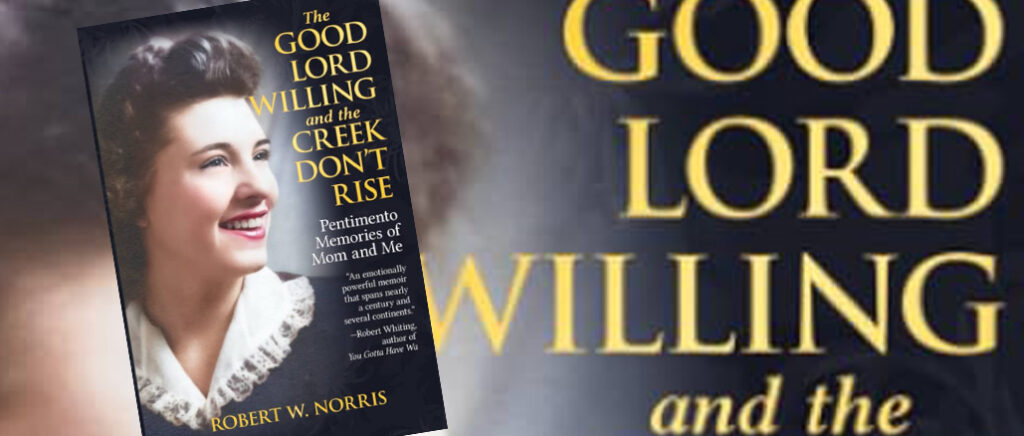
Title: The Good Lord Willing and the Creek Don’t Rise: Pentimento Memories of Mom and Me
Author: Robert W. Norris
Publisher: Manchester: Tin Gate, (2023)
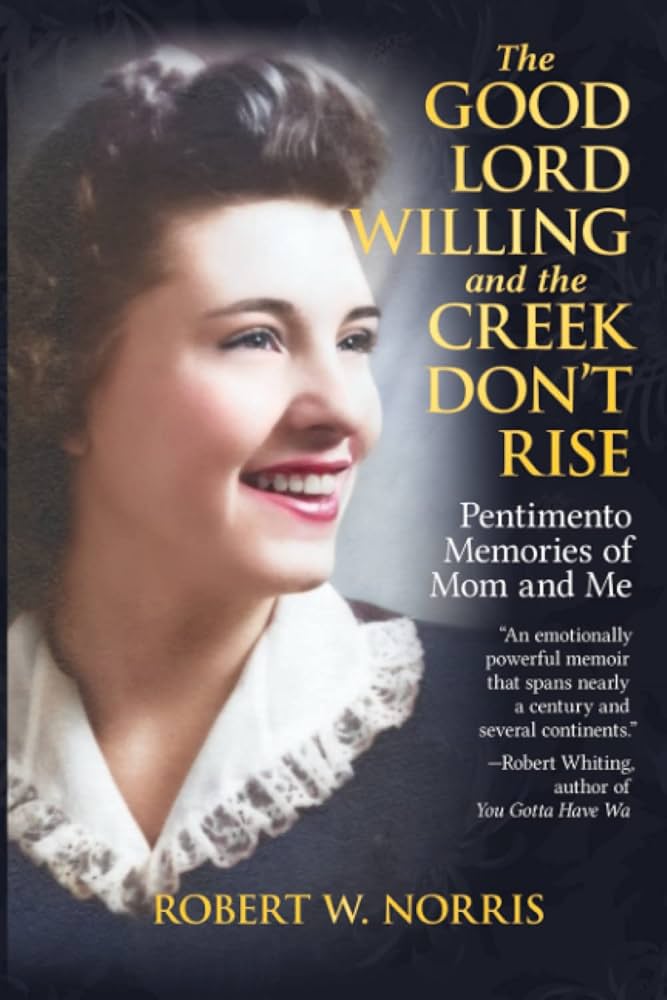
Memoirs like this seldom make their way into the hands of academics. Robert W. Norris’ account of his lifelong relationship with his mother, at first glance, judging by the glowing portrait of his mother gracing its cover and the less-than-auspicious, folksy title, an expression popularized in song by both Jerry Reid and Johnny Cash, hints at nothing of scholarly interest. Yet, a closer look reveals the story of not only the author’s coming of age story on the road to conscientious objection during the Vietnam War, but his mother’s own opprobrium in a conservative California town after her divorce, spurned by the Catholic Church she had relied on for years.
In an academic volume, chapter summations are essential, however the brief chapters provide only short glimpses of the broader themes of the memoir. The first book, which contains 12 chapters, is by far the most important. The author’s boyhood communities, each deep in the heart of conservative California, known for its attempted secessionary State of Jefferson[1] and long-held traditional values that blend small town politics, religion, and a sense of patriotism that often descend into forms of nationalism. Norris’ family are easily emblematic of these values, with his father William serving in the European Theater during World War II, flying the iconic P-38 Lightning. Returning a war hero, he and the rest of the family bought a local lumber company and the author grows up in and around the Church, with his mother playing the organ for the church choir, while young Robert “secretly [plays with his] plastic army men” (p. 73). Communities are also known to hide their private shame, with mentions of his mother’s failing marriage and later divorce hidden from the view of many, as both warmth and affection were often hidden for the sake of stoicism (p. 85-86).
The issue of conscientious objection has a long and problematic history since the passage of the 1940 Selective Service and Training Act[2], where those with religious, moral or ethical challenges to war were allowed to apply for work for the U.S government rather than actively participate in combat-related operations. Many were granted along religious grounds, and during the Vietnam War, being granted this exception was difficult as only 171,000 were granted CO status[3]. Norris escaped Humboldt County with an eye toward a better life, joining the U.S Air Force with his childhood friend Shannon in 1969 (p. 112). However, the details—the long philosophical and moral foundations for Norris’ objector realization—are underexplained. Assigned to be a military policeman is largely confined to a few chapters, where he tries to fake his way out of military service due to injury and later discovers a Supreme Court precedent[4] that allows moral objectors to file as well as religious ones (p. 119). These are the formative chapters that required a break from the narrative of his life story and more into the personal philosophical discoveries that fed his objection. For academics in the field of peace and conflict studies, this is critical information, and it is sparing at best. Norris is later court-martialed and sentenced to hard time in a military prison, where after a short stint of hard labor, is released. And unfortunately, as Book One comes to an end, the aspects of interest to scholars and historians come to an abrupt end.
While Book Two chronicles the events of a life well lived and an intimately touching portrait of a nomadic young man who makes his way to the far reaches of Asia, landing in Japan, where he forges a life, a marriage, and career in higher education. Periodically, Norris’ thoughts turn to his mother’s pain and her tireless support of him, despite her own financial and personal challenges. Her pride in him is visible in her poetry, where she extols his courage, writing to him that he had “been brave enough to follow your heart as you stand firm and are now defining your strength and masculinity..” (p. 402-403). And finally, as his career winds down, so too does his mother’s health. Reviewing Book Two in the traditional fashion would deprive the reader of the chance to discover a close relationship between mother and son and the complex social challenges that ties to California’s conservative Humboldt County can bring. The world of Norris’ childhood, his mother’s world, and the world beyond his court-martial are best left for the reader to discover alone.
While this is a touching memoir, it is not significant enough to warrant purchase by scholars for research purposes, nor is it justifiable for a place inside an institutional library. The editorial decision on the title and the front cover are serious mistakes, depriving many of a glimpse into what the story might be about. While it’s not appropriate to judge a book by its cover, many do, which ultimately will cost many the emotional experience of what is a powerful personal memoir.
Reviewed by Mark S. Cogan
Mark S. Cogan, Associate Professor of Peace and Conflict Studies, Kansai Gaidai University
[1] Hubler, S. (2021, May 26). The State of California’s ‘State of Jefferson.’ The New York Times. https://www.nytimes.com/2021/05/26/us/california-jefferson-secession.html
[2] Roosevelt, F.D. “Selective Service and Training Act of 1940.” World Affairs, vol. 103, no. 3, 1940, pp. 179–86.
[3] Peace and Service in Vietnam. (n.d.). Civilian Public Service Story. Retrieved November 27, 2023, from https://civilianpublicservice.org/storycontinues/vietnam
[4] The U.S Supreme Court reversed a ruling under United States v. Seeger, 380 U.S. 163 (1965) in Welsh v. United States, 398 U.S. 333 (1970).