


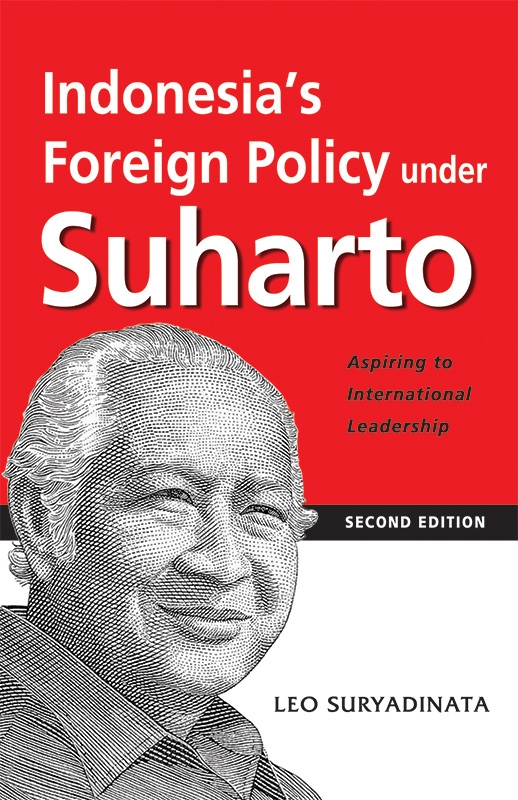
Title: Indonesia’s Foreign Policy under Suharto: Aspiring to International Leadership
Author: Leo Suryadinata
Publisher: Singapore: ISEAS-Yusof Ishak Institute, 2022
Leo Suryadinata’s book is among the very few books written on Indonesian foreign policy during the dictatorship era of Suharto and the rarity gets starker when we consider the books written by an Indonesian writer. As a result, Suryadinata’s book remains one of the most important references if one were to study or research about Indonesian foreign policy during the Suharto era. The book is known for its simple and lucid expressions, neat outline of key issues in Indonesian foreign policy and a concise explanation of principal traits of Indonesian foreign policy in general.
On popular demands, Suryadinata has published a second edition of the book in 2022 that has retained the entirety of the first edition and added a 29-page Postscript to the book. His main objective is to reflect his current thinking on Indonesia’s foreign policy since the departure of Suharto.
The second-edition book can be divided into three parts. The first part contains four chapters laying down the author’s understanding of the fundamentals of Indonesian foreign policy. The second part contains seven chapters that deal with various case-specific aspects of Indonesia’s foreign relations, such as relations with the ASEAN States, relations with superpowers, relations with China, and relations with the Non-Aligned Movement. The third part of the book contains a Postscript that analyzes Indonesian foreign policy during the last twenty-five years.
The new book carries on with the original question – Indonesia’s quest for international leadership and resolves the question with two inter-related arguments. First, the search is perennial as the post-colonial Indonesia continues to aspire for international leadership during the third decade of the 21st century. This is an important aspect and takeaway of the book – an unfinished quest or a perpetual question for the foreign policy elite of the country. Second, the author believes that not only has Indonesia struggled to aspire for international leadership, but its regional leadership has also declined during the presidency of Joko Widodo due to the latter’s focus on domestic politics and economic diplomacy.
One of the most important contributions of the postscript to the Indonesian foreign policy debate is its analysis of what has changed and continued over time. The author underlines two important domestic changes that have come to shape Indonesian foreign policy making in the democratic era – rise of the Indonesian parliament as an important foreign policy actor and the emergence of Islam as an important variable. Both these changes highlight democratizing tendencies in the country’s foreign policy making process as they bring the law-makers and the government-makers into the foreign policy debates. This also means more restraint on the political executive and politicization of foreign policy.
Similarly, the external environment of Indonesia, according to the author, has also undergone fundamental transformation with the rise of China and the relative decline of the United States. However, Suryadinata is nuanced and does not play the game of rise and decline. He rather identifies policy choices of political leaders as a critical factor in shaping Indonesia’s relations with the two major powers. For example, Indonesia’s relations with the US grew stronger during the Yudhoyono presidency since Susilo Bambang Yudhoyono, who was trained in the US and had an outward focus, shared a favourable disposition towards the US. On the other hand, Indonesia’s relations with China have grown stronger during the Widodo presidency due to President Joko Widodo’s focus on economic diplomacy and development. While the Yudhoyono presidency saw the presence of the US military in the aftermath of the 2004 Tsunami in the northernmost province of Aceh, the Widodo presidency saw the presence of Chinese defense forces in the Indonesian waters to assist in the recovery of the sunken Indonesian submarine in the Bali Sea in May 2021. In other words, he underlines the autonomy and agency of Indonesia in shaping its major power relations as expressed in the form of predilections and choices of the country’s leaders.
The 29-page postscript is no match for the original masterpiece. Though it carries the same style and flow as the rest of the book, it suffers from brevity as the author provides limited details on some of the new developments that he himself describes as major changes. A brief postscript does not do justice with the scale and complex outlook that Indonesian foreign policy making process has acquired during the 25 years after the end of the Suharto era. Its discussion of major powers is brief and largely descriptive, offering limited analytical value for the readers.
The academic and analytical value of the original book comes from, among other things, the paucity of writings on Indonesian foreign policy during the Suharto era. In contrast, the postscript must compete with a large amount of literature both Indonesian and non-Indonesian that has come up during the post-Suharto era. In other words, the utility of the postscript will depend on what it brings to the foreign policy debate as opposed to a sizable inventory of books detailing different aspects of Indonesian foreign policy and strategic thinking in the 21st century.
Though the postscript is a great read, it leaves a reader somewhat unsatisfied. I agree with the author’s note that the book should have remained as it was. Instead, the author should have written another book detailing in his own style Indonesia’s foreign policy during the last three decades. A new book would have provided the readers rich details and an important reference for the quality insight that the author is famous for.
Reviewed by Vibhanshu Shekhar
Vibhanshu Shekhar is an Adjunct Professor at American University.