

The globalization of academic research has facilitated the exchange of knowledge across borders, contributing to the advancement of scholarship in various disciplines. Within this context, the emergence of predatory journals indexed in prestigious databases like the ISI poses significant challenges to the integrity and credibility of scholarly publishing, including research related to Vietnam on a global scale. These journals, driven by profit motives rather than academic rigor, exploit the academic community by offering publication opportunities without adequate peer review or editorial oversight. In this paper, we explore the phenomenon of predatory journals within the ISI index, with a particular focus on the implications for global research on Vietnam. By identifying and analyzing suspicious journals, we aim to shed light on the extent of this issue and advocate for measures to safeguard the integrity of academic publishing within the context of Global Vietnam studies
Setting the stage
In this article, I utilize the concepts of “ISI (Institute for Scientific Information) predatory journals” and “Scopus (Science Citation Index Expanded) predatory journals” to refer to journals identified as predatory within the reputable journal lists of the Web of Science (WoS) by ISI, and Scopus by Elsevier, collectively referred to as “reputable predatory journals.” The discussion scope is confined to the humanities disciplines (distinct from the social and natural sciences).
Humanities: The Classic Strongholds
The humanities field is often considered “useless,” “outdated,” and “academically inferior” due to its low publication output (especially in high-ranking international publications) compared to fields in the natural and social sciences. In reality, the most significant part of the humanities lies in specialized studies. Secondly, the research objects are things that reside in the human mind, highly abstract, such as thoughts, philosophy, aesthetics (literature, arts), historical perception (historiography)… These studies often require time and effort but do not yield immediate results, especially economic ones. The “lethargic” economic model, with no labs, no “technical applications for production,” leads humanists to live and work quietly. To this day, humanities journals still retain the classic publishing model: the publisher is usually a research or educational institution. A humanities researcher typically has only one publication (in an SSCI/AHCI journal) within 1 to 2 years, or even longer.
The nature of research in the humanities renders the publication models of this field unable to prioritize quantity of publications. By examining some reputable journals in the humanities field, we find that the Journal of Vietnamese Studies (JVS), hosted by the Center for Southeast Asia Studies at the University of California Press since its establishment in 2006, has published a total of 299 research articles (out of a total of 619 articles, including book reviews, introductions, and research articles) to date. Thus, over 18 years, JVS has averaged 16 publications per year, with each issue containing 4 research articles. Another journal, the Journal of Asian Studies, published by Cambridge University Press (since 1941), under the auspices of the Association for Asian Studies (AAS), only publishes 4 research articles per issue. The Sungkyun Journal of East Asian Studies, currently published by Duke University Press, has been in publication since 2001. From 2001 to 2009, it averaged 20 articles per year (2 issues). After being indexed in Scopus and ISI (2010 to present), this journal has averaged 10 articles per year (5 articles per issue). This indicates that serious journals tend to limit the number of articles while increasing research quality. Furthermore, it is noteworthy that these journals do not charge publication fees for authors. To date, journals and humanists worldwide continue to be classic strongholds.


However, in the past seven years, amidst the surge of publication demands characterized by a “quantity-over-quality” mindset, especially the fever of prioritizing publications in ISI-Scopus indexed journals almost as a “golden yardstick,” many scholars in the humanities sector in Vietnam have fallen victim to cunning predatory journals. Indeed, some individuals, once preyed upon, have transformed into predators themselves, seeking out these predatory journals. Meanwhile, numerous government agencies are utilizing these predatory publications for project evaluation, scientific achievement recognition, doctoral dissertation assessment, professorship/promotion evaluation, and recognition of outstanding educators. This is an alarming phenomenon. Professor Ngô Việt Trung (former Director of the Institute of Mathematics, Vietnam) asserts: “The act of scientists publishing their work in international journals under false pretenses to be evaluated for scientific research achievements is a violation of scientific ethics, and even more serious is the act of ‘selling articles’. [1]
Currently, when evaluating the ranking of scientific journals, Vietnam’s approach often relies on existing foreign listings, exemplified by ISI and Scopus, while disregarding national standards from France, Japan, Korea, China, etc. Although this method has its basis, it also has several shortcomings. ISI-Scopus is not an absolutely precise gold standard, as some journals may transform into predatory ones for quick “harvesting” within a few years of being listed. ISI-Scopus continually updates by adding new emerging journals and concurrently removes predatory ones from its listings. This means that reputable lists are subject to constant change. At any given time, a certain proportion of predatory journals of low quality are present in the ISI-Scopus listings.
Therefore, the most pressing issue in Vietnam currently is instead of blindly accepting the ISI-Scopus listings (based on others), we need to identify the evaluation criteria used by ISI and Scopus for journals. Instead of adhering strictly to an existing (yet ever-changing) list, we can establish fundamental criteria encompassing basic features to identify predatory journals within the ISI-Scopus listings.

Striving for Excessive Profit
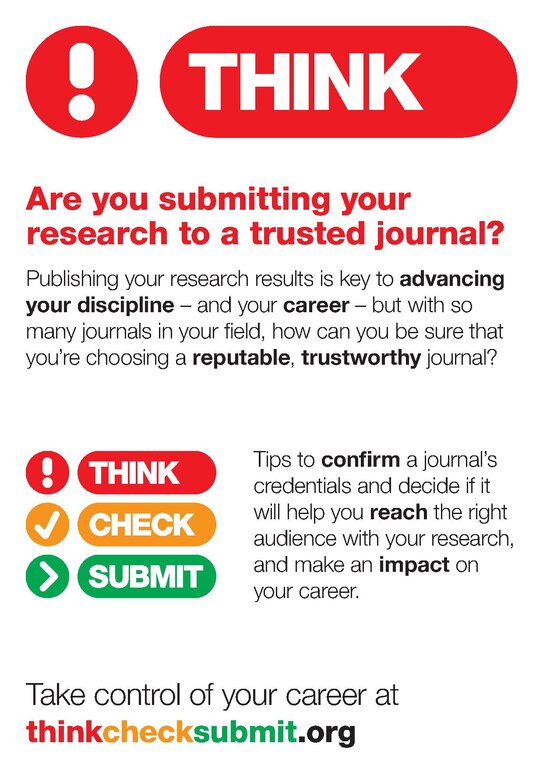
Predatory journals (also known as deceptive journals) are a publishing model of scientific publications aimed at profitable business by “preying on” their prey (customers who pay to have their papers published) without regard for scientific content and quality. Although the Nafosted Fund currently lacks any legal document on predatory journals and criteria for identifying them, we can find the following definition on the official website of the Nafosted Fund: “Predatory scientific journals (predatory, write-only, deceptive publishing) engage in business-oriented academic publishing related to publishing fees without quality checks and other publishing services provided by legitimate scholarly journals (whether open access or not). Authors are deceived or, in some cases, intentionally publish journals of poor quality. – Some journals require fees for processing low-quality articles, provide superficial scientific evaluation, and offer short publication times. Fees can range from hundreds to thousands of USD per publication.” [2] According to the Cabells Predatory Report in 2022, there are over 15,500 predatory journals worldwide. [3] These predatory journals exhibit various forms and their numbers are increasing rapidly, with complex mutations, cunning tricks, and tactics that deceive both customers and managers.
Considering ISI (or a reputable international publisher) as a rigid criterion leads many to adopt a behavioral pattern where articles published in WoS journals are considered credible, beyond debate, and simply accepted (whether for admission review, outcome evaluation, or professorial standards). This is a somewhat complacent approach. In reality, although WoS is a reputable platform with a wealth of content, it is a dynamic repository with its own share of predatory listings.
The strategy of many journals is to aspire for inclusion in ISI, but once listed, they begin to capitalize by increasing the volume of publications. Typically, a humanities journal publishes only 2 to 10 articles per issue, each averaging between 20 to 50 pages. During the pursuit of ISI listing, journals often build their brand by ensuring compliance with all the stringent criteria of an academic journal. However, once listed in ISI, they immediately transition to a predatory model. To boost revenue, they gradually ramp up the number of publications at an exponential rate.
Criteria for Identifying Predatory Journals
As mentioned above, some organizations in Vietnam, such as the Ministry of Science and Technology or the Ministry of Education and Training, have been using ISI-Scopus as rigid standards for evaluating research articles and scholars. However, this should only be a “mechanical fence.” What needs to be done now is to establish criteria to identify the signs of predatory journals, as a basis for evaluating journal quality. Through interviews and consultations with numerous scholars from various fields, I believe that relying on just 1-2 criteria is insufficient; rather, a collection of various criteria needs to be met. When these criteria are present together, it is the basis for identifying predatory journals. The more criteria are met, the clearer the signs of predation become. This means that predatory journals will have different levels. Below, I will present each criterion and also analyze in depth the indicators of poor quality in some journals in the humanities that I have come to know.
Criterion 1: Poor-quality articles, with many translation errors and fundamental misconceptions
An important criterion for identifying predatory journals is the quality of the articles. Due to the emphasis on the quantity of publications, and the rapid publication pace to drive profit from scientific publishing, these journals have often published many low-quality articles.
In terms of scientific content, a reputable international journal typically engages in theoretical dialogue and discusses a specific issue that the scientific community is concerned about. Articles often need to have a clear argument and novelty. On the other hand, an article published in a predatory journal (approved by individuals outside the field or with shallow expertise) tends to be superficial, offering little contribution to general knowledge or lacking an international academic foundation, sometimes merely rehashing previously published findings. Typically, the assessment of scientific content belongs to experts and academic councils in the field.
Regarding language errors, articles published in predatory journals often contain numerous English language errors with various humorous styles. Here are some examples of knowledge errors in an article published in Humanities and Social Sciences Communications (HSSC) by Springer Nature, ranked SSCI & AHCI in WoS/ISI. One paper about medieval Vietnamese literature has many grammatical errors.[4] From minor errors such as 1/ “vua Lê Thánh Tông” translated as “Lê Thánh Tông King” (should be translated as “King Lê Thánh Tông”); similarly, “vua Thiệu Trị” translated as “Thiệu Trị King”, “An Dương Vương” translated as “An Dương Vương King”, 2/ “tự sự của trinh tiết” translated as “naratives of chastify”, mistaking the spelling between “chastity” and “chastify”; to more serious errors such as “biển gỗ” translated as “wooden sea”, which should be translated as “wooden plaque”. This is likely a Google Translate error. Or basic knowledge errors like the famous book “Thần, Người và Đất Việt” mistakenly written as “Thần và Người đất Việt”, then mistranslated as “Vietnamese God and Man” (should be “Vietnamese Spirits, Man and Land”). This article also contains many other errors regarding historical knowledge: “Kinh đô Trà Bàn” is translated as “Trà Bàn’s capital” (capital of Trà Bàn). This translation lacks basic historical knowledge; the author does not know that this was the capital of the ancient Champa kingdom. Secondly, this capital should actually be “Đồ Bàn” (闍槃, according to some historical records).[5] Another error is “Champa’s Bàn La Trà King”, while the name of this Champa king is “Bàn La Trà Toàn” (槃羅茶全), missing the character Toàn and misplacing King. These are quite basic errors regarding Vietnamese historical and cultural knowledge in general, not to mention specialized knowledge. Including spelling errors, editing errors, argument errors, and knowledge errors, this article has nearly 100 errors in 8 pages. Truly a record-breaking number!
Criterion 2: Publication Fees
Journals charge fees from authors for publication services. Currently, the market for publishing scientific articles has various price ranges, from 500 USD to 5000 USD or more. Both the natural and social sciences fields have many reputable journals that also charge fees. Meanwhile, many reputable journals in the humanities field do not charge any publication fees. Opting to publish in fee-free journals is safer than venturing into fee-charging journals.
Criterion 3: Increasing Number of Publications
The practice of charging fees alongside increasing the number of published articles aims to create a profitable business model, akin to a money-making machine. This phenomenon is particularly notable as the standards for journal publication within the ISI and Scopus listings are applied across many countries, especially those outside the Anglo-American sphere. Consequently, funds are distributed and flow through various channels. For instance, the aforementioned HSSC journal charges a publication fee of 1,690 USD per article. Despite being established only since 2015, this journal is showing signs of becoming a lucrative venture.
| Year | Number of articles | Publication fee for each article (USD) | Revenue |
|---|---|---|---|
| 2015 | 34 | 1690 | 57.460 USD |
| 2016 | 73 | 1690 | 123.370 USD |
| 2017 | 130 | 1690 | 219.700 USD |
| 2018 | 110 | 1690 | 185.900 USD |
| 2019 | 133 | 1690 | 224.770 USD |
| 2020 | 262 | 1690 | 442.780 USD |
| 2021 | 290 | 1690 | 122.640 USD |
| 2022 | 400 | 1690 | 676.000 USD |
| 2023 | 899 | 1690 | 1.519.310 USD |
| 2024 (until April) | 462 | 1690 | 780,780 USD |
Looking at the table above, we can divide it into three phases: (1) an initial phase with a moderate number of publications (ranging from 34 to 73 articles per year); (2) an accelerating phase with numbers increasing from 130 to 290 articles per year; (3) an exponential phase with article numbers ranging from 400 to 899. Therefore, in 2023, the total revenue of this journal was $1,500,000 (over one and a half million USD, equivalent to over 37 billion VND). As of April 18, 2024, the number of articles published is 462 (amounting to $780,780). At this rate, in 2024, HSSC is projected to publish approximately 1,600 articles (which means publishing more than 4 articles per day!!!) and is expected to generate revenue of $2,704,000 (equivalent to 67 billion VND).[6]
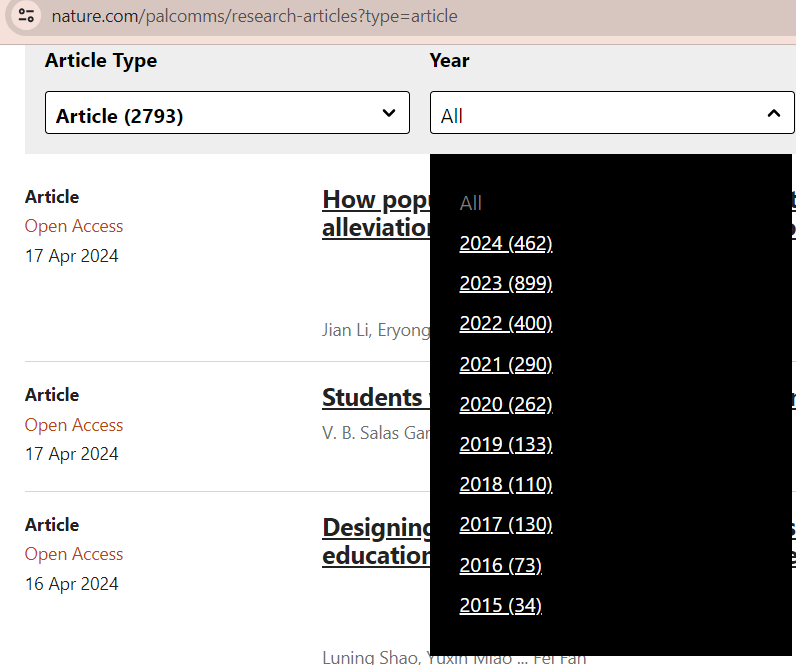
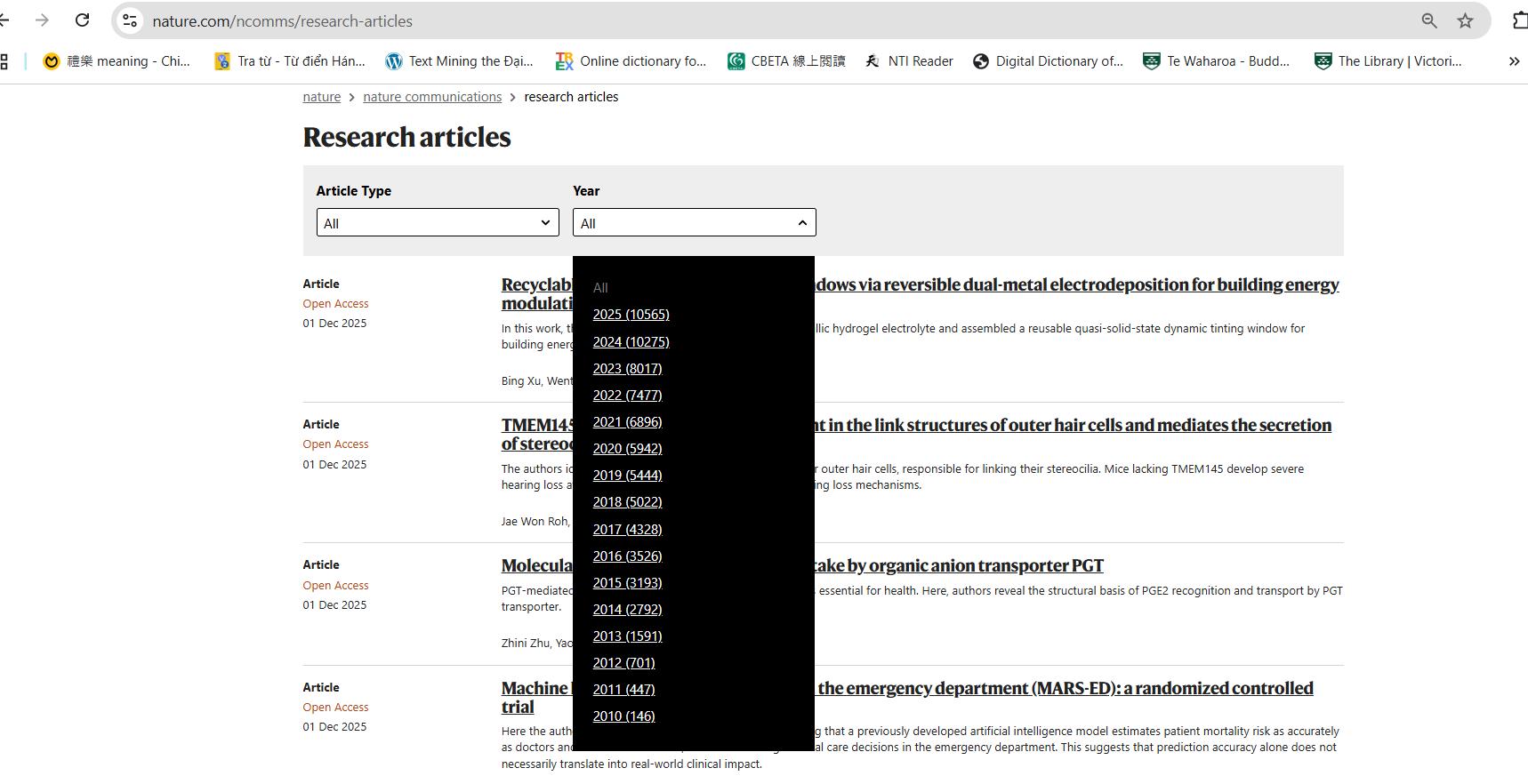
A “sneaky” point of this journal is that all articles are numbered from page 1 to the end of the article (depending on the length of each article). This approach aims to conceal the very large number of pages in each issue of the journal. And the second “sneaky” point is that there is only one issue per year.
Criterion 4: Opaque Editorial Board
The editorial board and peer review process are often regarded as the “soul” of a journal. Particularly for specialized journals, the composition of the editorial board serves as “evidence of assurance” for the credibility of the journal. Members of these editorial boards are typically leading experts in specific narrow fields. Some reputable journals nowadays not only list the sponsoring institution but also provide links to the scientific profiles on the homepage of the affiliated organization and even Orcid accounts. (For example, Andrey Dvornichenko, Editor-in-Chief of the Vestnik of Saint Petersburg University – History, link: https://orcid.org/0000-0003-4813-7340). In my view, a good editorial board comprises a group of specialized scholars in a specific discipline (e.g., Sinology, history…) or research field (e.g., Vietnamese studies, East Asian studies…).
Criterion 5: Short Publication Review Time
Specialized journals often undergo rigorous editing through multiple rounds of review, including: 1/ initial screening, usually conducted by the editorial team; 2/ blind peer review (2-3 anonymous reviewers), typically experts in the field; 3/ editorial review (by the editors). The first two rounds involve technical assessment (theory, methodology, argumentation…). The final round (divided into several editing phases) typically addresses language refinement, spelling errors, journal formatting, etc. The editing, discussion, and revision process often lasts from 12 to 24 months, or even longer. Predatory journals often mimic this process precisely to “disguise” themselves as serious journals, but the time frame tends to decrease. Some journals have published articles within a few months, even a few weeks!
So, summarizing, we have at least 6 criteria to identify predatory journals in the field of humanities research, presented in the table below.
| No. | Criterion | Predatory journal | Prestigous journal |
|---|---|---|---|
| 1 | Fee | 500-1,500 USD or more | No fee. |
| 2 | Business model | 899 articles in one year (2023). Publishing many articles to generate revenue, rapid increase in publications after being indexed in ISI-Scopus. | -10 articles per issue, 16-40 articles per year. Not profit-driven. Because the scholars are salaried at universities and institutions. |
| 3 | Editorial Board | Unclear specialization and affiliations. | Clear specialization and affiliations. |
| 4 | Publication review time | A few weeks to a few months. | 1 year to 3 years. |
| 5 | Scientific quality | Low | High, very high. |
| 6 | Language and editing quality | Many grammatical errors, translation errors, editing errors. | Very few errors, or almost none. |
Conclusion
Vietnam is currently swept up in the global capitalist publishing storm. Our scientific standards are currently being adopted based on the rigid criteria of capitalist conglomerates and Western research institutions, without having established national standards like China’s CSSCI or South Korea’s KSSCS. Currently, we are overlooking many scientific centers, scientific traditions due to the “Euro-centrism” in science management. I have previously advised the Nafosted Fund on this issue in 2017, and it has been published in Tia Sáng.[8]
The downside of capitalism is its drive to maximize profit in business models. Its effect is to boost labor productivity and global scientific publications. However, its repercussions include the “hurricane of counterfeit journals,” encompassing all sorts of predatory journals.
To counter this trend, numerous countries are simultaneously establishing national and international standards while erecting legal barriers as “filters” to guide the healthy development of science. In 2018, the General Office of the Central Committee of the Communist Party of China issued a directive urging agencies to compile a list of problematic journals to help Chinese researchers avoid falling prey to predatory practices. In 2020, the Chinese Academy of Social Sciences published a list of suspicious journals under warning, comprising 65 ISI/WoS journals: 16 in Q1, 27 in Q2, 13 in Q3, and 7 in Q4. The predatory nature of ISI is real. These 65 journals published 51,000 articles from China (5% of total publications in 2020), resulting in a loss of up to 96 million USD. Among them, journals were published by Wiley (5), Elsevier (3), Springer (3), Hindawi (3), Taylor & Francis (2), SAGE (2), and MDPI (22). [9] In 2023, France also identified 3,400 predatory journals in the fields of Health and Life Sciences.
I believe that Vietnam’s leading scientific agencies (such as the Ministry of Science and Technology, the Academies of Sciences, and National Universities) should provide advisory documents to the state to establish comprehensive and systematic strategies and policies. To emulate China or France, we need to establish a system of criteria to identify predatory journals, moving towards creating a “blacklist” for these “reputable predatory” journals, and then implementing it in practice.
In sum, the proliferation of predatory journals within the ISI index presents a significant challenge to the integrity of research related to Global Vietnam. The identification of nearly 100 suspicious publications underscores the urgency of addressing this issue to uphold the standards of academic excellence and promote credible scholarship in the field. As Vietnam increasingly becomes a focal point for global research and collaboration, it is essential to implement robust regulatory measures to mitigate the influence of predatory publishing practices. By fostering transparency, accountability, and collaboration among stakeholders, including academic institutions, funding agencies, and publishers, we can safeguard the integrity of research on Vietnam within the global academic community. This paper serves as a call to action for concerted efforts to combat predatory publishing and uphold the credibility of scholarship in the context of Global Vietnam studies.
Tran Trong Duong
Associate Professor, Institute of Sino-Nom Studies, Vietnam Academy of Social Sciences.
A version was published originally in Vietnamese in Tia sáng, May 4, 2025.
NOTES
[1] “Đăng bài ở tạp chí mạo danh, có vô can?” [“Publishing articles in predatory journals, any innocence?]” – Thanh Nien Newspaper, link: https://thanhnien.vn/tin-tuc-giao-duc-dac-biet-19-2-dang-bai-o-tap-chi-mao-danh-co-vo-can-1851430920.htm
[2] Trương Thị Thanh Huyền, “Trao đổi với các Hội đồng khoa học ngành nhằm nâng cao chất lượng công bố của các đề tài nghiên cứu cơ bản do Quỹ tài trợ” [Exchange with Scientific Committees to Improve the Quality of Publications of Funded Basic Research Projects], 14/06/2020, link: https://nafosted.gov.vn/trao-doi-voi-cac-hoi-dong-khoa-hoc-nganh-nham-nang-cao-chat-luong-cong-bo-cua-cac-de-tai-nghien-cuu-co-ban-do-quy-tai-tro/
[3] M. Hà-Dương, “Truy cập mở: Giấc mơ lãng mạn ? [Open Access: A Romantic Dream?]” Tia Sáng newspaper, vol. 1+2, pp. 34–39, Jan. 10, 2023.
[4] Title of this paper is omitted by anonymous translator (s).
[5] As far as I can guess, the original text used words “荼槃” (another type of transcription), but was copied or misread as “茶槃”. This ever formed the debate about “đóa đồ mi” or “đóa trà mi” among Kieu academic circles at one time
[6] In the latest update, in 2024, this journa published nearly 1700 articles. Such a huge revenue!
[7] The information is as of March 2025. The information is added in the translation for the latest update about the extremely fast rising of published articles in HSSC.
[8] Trần Trọng Dương, “Quỹ NAFOSTED: cần mở rộng khung tiêu chuẩn công bố quốc tế” [NAFOSTED Fund: Need to Expand International Publication Standards], Tia sáng, 18/06/2017, link: https://tiasang.com.vn/quan-ly-khoa-hoc/quy-nafosted-can-mo-rong-khung-tieu-chuan-cong-bo-quoc-te-10759/
[9] According to Dương Tú (interviewee) and Nghiêm Huê (interviewer) “Cảnh báo gần 100 tạp chí thuộc danh mục ISI đáng ngờ” [Warning about nearly 100 suspicious ISI-listed journals], Tiền phong newspaper, 30/05/2022, link: https://tienphong.vn/canh-bao-gan-100-tap-chi-thuoc-danh-muc-isi-dang-ngo-post1442074.tpo